• Wyszukiwanie zaawansowane
  • Kategorie
  • Kategorie BISAC
  • Książki na zamówienie
  • Promocje
  • Granty
  • Książka na prezent
  • Opinie
  • Pomoc
  • Załóż konto
  • Zaloguj się

The Myth of the Powerless State : Governing the Economy in a Global Era » książka


zaloguj się | załóż konto
Logo Krainaksiazek.pl

koszyk

konto

szukaj
topmenu
Księgarnia internetowa
Szukaj
Książki na zamówienie
Promocje
Granty
Książka na prezent
Moje konto
Pomoc
 
 
Wyszukiwanie zaawansowane
Pusty koszyk
Bezpłatna dostawa dla zamówień powyżej 20 złBezpłatna dostawa dla zamówień powyżej 20 zł

Kategorie główne

• Nauka
 [2950560]
• Literatura piękna
 [1849509]

  więcej...
• Turystyka
 [71097]
• Informatyka
 [151150]
• Komiksy
 [35848]
• Encyklopedie
 [23178]
• Dziecięca
 [617388]
• Hobby
 [139064]
• AudioBooki
 [1657]
• Literatura faktu
 [228597]
• Muzyka CD
 [383]
• Słowniki
 [2855]
• Inne
 [445295]
• Kalendarze
 [1464]
• Podręczniki
 [167547]
• Poradniki
 [480102]
• Religia
 [510749]
• Czasopisma
 [516]
• Sport
 [61293]
• Sztuka
 [243352]
• CD, DVD, Video
 [3414]
• Technologie
 [219456]
• Zdrowie
 [101002]
• Książkowe Klimaty
 [124]
• Zabawki
 [2311]
• Puzzle, gry
 [3459]
• Literatura w języku ukraińskim
 [254]
• Art. papiernicze i szkolne
 [8079]
Kategorie szczegółowe BISAC

The Myth of the Powerless State : Governing the Economy in a Global Era

ISBN-13: 9780745615820 / Angielski / Miękka / 1998 / 280 str.
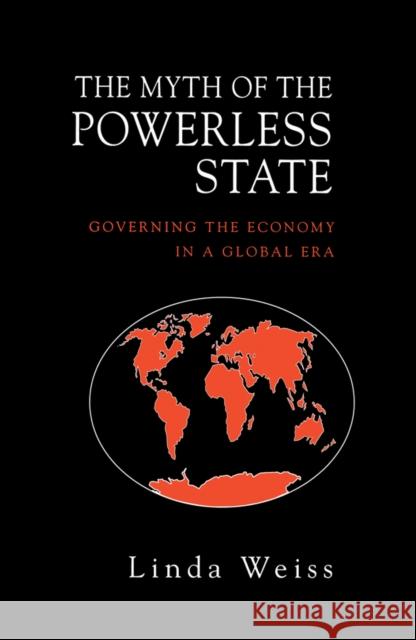
Linda Weiss
The Myth of the Powerless State : Governing the Economy in a Global Era Linda Weiss 9780745615820 Polity Press - książkaWidoczna okładka, to zdjęcie poglądowe, a rzeczywista szata graficzna może różnić się od prezentowanej.

The Myth of the Powerless State : Governing the Economy in a Global Era

ISBN-13: 9780745615820 / Angielski / Miękka / 1998 / 280 str.

Linda Weiss
cena 97,10
(netto: 92,48 VAT:  5%)

Najniższa cena z 30 dni: 96,51
Termin realizacji zamówienia:
ok. 30 dni roboczych
Dostawa w 2026 r.

Darmowa dostawa!

It is widely claimed that as the integration of the world economy advances, national governments are becoming less relevant, losing their powers not only to influence macroeconomic outcomes and to implement social programmes, but to determine strategies for managing the industrial economy. In the face of such claims of state powerlessness, this book proposes that what lies behind some of the most successful economics today is a series of state-informed and state-embedded institutions for governing the economy.


The book's central proposition is that the impact of external economic pressures is to a large degree domestically determined, varying in important measure according to the robustness or weakness of national institutions. This thesis is advanced through an analysis of the sources and varieties of state capacity for governing industrial transformation. Focusing on the unravelling of Sweden's distributive model of adjustment, on the evolution of developmental states in East Asia, as well as on the parallel strengths of the German and Japanese systems of industrial co-ordination, it is shown how different types of state capacity - "developmental," "distributive" and "dual" - impact on industrial vitality and domestic adjustment to the international economy. The comparative perspective developed in this study indicates that, as world economic integration proceeds, state capabilities will matter more rather than less in fostering social well-being and wealth creation.


This book will be essential reading for 2nd- and 3rd-year undergraduates in comparative politics, political economy and political sociology as well as to all those who have an interest in the nature and prospects of the state in the face of changes to the world economy.


Kategorie:
Nauka, Socjologia i społeczeństwo
Kategorie BISAC:
Social Science > Socjologia
Wydawca:
Polity Press
Język:
Angielski
ISBN-13:
9780745615820
Rok wydania:
1998
Ilość stron:
280
Waga:
0.42 kg
Wymiary:
23.2 x 16.5 x 1.6
Oprawa:
Miękka

"I can unreservedly recommend this book as easily the most intelligent, best–researched and original account available of the relations between states and capitalist economies in the advanced North. Linda Weiss′s careful dissections of economic policies and performance in Japan and East Asia, Sweden, Germany, Britain and the United States demolishes most conventional generalizations deriving from neo–liberal, "globalization" or social democratic theories alike. This is macro–sociology of the highest quality." Professor Michael Mann, UCLA

"This is a splendid study in political economy. Weiss uses the comparison between East Asia, Sweden and Germany as the basis for a theoretical analysis of the role of the state as a coordinator and steerer of industrial upgrading. Her style is punchy, her argument is original. Future research will have to take The Myth of the Powerless State as a point of reference." Professor Robert Wade, Russell Sage Foundation, New York

"Articulate, engaging and highly persuasive ... this is a fine work. And it is easily the best attempt so far to reinstate the anti–liberal, pro–state, economically national cause." Australian Journal of Political Science

"Her statement of a case against leaving things to markets that are currently influential is clear and thoughtful, and her argument deserves attention from both sides of the political divide." Times Literary Supplement

"A welcome contribution to the ongoing debate over globalization. This book provides the best general discussion of state power yet available." Foreign Affairs

Preface.

1. The State is Dead. Long Live the State.

Introduction.

The Phenomenon of ′State Denial′.

Scope of the Argument.

The Book in Outline.

2. The Sources of State Capacity. .

Introduction.

The Problem of State Capacity.

Approaches to State Capacity.

Conclusion.

3. Transformative Capacity in Evolution: East Asian Developmental States.

Introduction.

Institutions and Economic Performance.

Institutional Capacities for Industrial Transformation.

The Changing Basis of State Capacity.

Forms and Dynamics of Governed Interdependence.

Conclusion: State ′Power′ in East Asia.

4. Limits of the Distributive State: Swedish Model or Global Economy? .

Introduction.

Distributive State Capacity.

The Model Unravels: External Pressures?.

Undermining from Within.

The Limits of a Distributive Strategy.

Explanations of the Swedish Strategy.

Conclusion.

5. Dualistic States: Germany in the Japanese Mirror.

Introduction.

The German Case: How ′Developmental′ is the State?.

The State in the Rise of German Industrial Power. Geopolitical Submergence of Transformative Capacity.

Private–Sector Governance: A State–informed System of Coordination.

Postwar Developmentalism: Innovation Without Change.

Reconstituting Transformative Capacity.

Dual Capabilities and National Prosperity.

How ′Distributive′ is the Japanese State?.

Conclusion.

6. The Limits of Globalization. Introduction.

What does ′Globalization′ Mean?.

The Question of Novelty.

The Question of Magnitude.

The Question of Distribution.

The Question of Mobility.

7. The Myth of the Powerless State.

The Extent of Government Powerlessness.

Convergence Versus Varieties of State Capacity.

Adaptivity of the State.

The State as Victim of Midwife of ′Globalization′.

The Emergence of ′Catalytic′ States.

Conclusion.

Notes.

Bibliography.

Index.

It is widely claimed that as the integration of the world economy advances, national governments are becoming less relevant, losing their powers not only to influence macroeconomic outcomes and to implement social programmes, but to determine strategies for managing the industrial economy. In the face of such claims of state powerlessness, this book proposes that what lies behind some of the most successful economics today is a series of state–informed and state–embedded institutions for governing the economy.


The book′s central proposition is that the impact of external economic pressures is to a large degree domestically determined, varying in important measure according to the robustness or weakness of national institutions. This thesis is advanced through an analysis of the sources and varieties of state capacity for governing industrial transformation. Focusing on the unravelling of Sweden′s distributive model of adjustment, on the evolution of developmental states in East Asia, as well as on the parallel strengths of the German and Japanese systems of industrial co–ordination, it is shown how different types of state capacity – "developmental", "distributive" and "dual" – impact on industrial vitality and domestic adjustment to the international economy. The comparative perspective developed in this study indicates that, as world economic integration proceeds, state capabilities will matter more rather than less in fostering social well–being and wealth creation.


This book will be essential reading for 2nd– and 3rd–year undergraduates in comparative politics, political economy and political sociology as well as to all those who have an interest in the nature and prospects of the state in the face of changes to the world economy.

Weiss, Linda LINDA WEISS is Professor of Government and Interna... więcej >


Udostępnij

Facebook - konto krainaksiazek.pl


Opinie o Krainaksiazek.pl na Opineo.pl

Partner Mybenefit

Krainaksiazek.pl w programie rzetelna firma Krainaksiaze.pl - płatności przez paypal

Czytaj nas na:

Facebook - krainaksiazek.pl
  • książki na zamówienie
  • granty
  • książka na prezent
  • kontakt
  • pomoc
  • opinie
  • regulamin
  • polityka prywatności

Zobacz:

  • Księgarnia czeska

  • Wydawnictwo Książkowe Klimaty

1997-2025 DolnySlask.com Agencja Internetowa

© 1997-2022 krainaksiazek.pl
     
KONTAKT | REGULAMIN | POLITYKA PRYWATNOŚCI | USTAWIENIA PRYWATNOŚCI
Zobacz: Księgarnia Czeska | Wydawnictwo Książkowe Klimaty | Mapa strony | Lista autorów
KrainaKsiazek.PL - Księgarnia Internetowa

Polityka prywatnosci - link
Krainaksiazek.pl - płatnośc Przelewy24
Przechowalnia Przechowalnia





