• Wyszukiwanie zaawansowane
  • Kategorie
  • Kategorie BISAC
  • Książki na zamówienie
  • Promocje
  • Granty
  • Książka na prezent
  • Opinie
  • Pomoc
  • Załóż konto
  • Zaloguj się

Discourse Analysis: The Sociolinguistic Analysis of Natural Language » książka


zaloguj się | załóż konto
Logo Krainaksiazek.pl

koszyk

konto

szukaj
topmenu
Księgarnia internetowa
Szukaj
Książki na zamówienie
Promocje
Granty
Książka na prezent
Moje konto
Pomoc
 
 
Wyszukiwanie zaawansowane
Pusty koszyk
Bezpłatna dostawa dla zamówień powyżej 20 złBezpłatna dostawa dla zamówień powyżej 20 zł

Kategorie główne

• Nauka
 [2949965]
• Literatura piękna
 [1857847]

  więcej...
• Turystyka
 [70818]
• Informatyka
 [151303]
• Komiksy
 [35733]
• Encyklopedie
 [23180]
• Dziecięca
 [617748]
• Hobby
 [139972]
• AudioBooki
 [1650]
• Literatura faktu
 [228361]
• Muzyka CD
 [398]
• Słowniki
 [2862]
• Inne
 [444732]
• Kalendarze
 [1620]
• Podręczniki
 [167233]
• Poradniki
 [482388]
• Religia
 [509867]
• Czasopisma
 [533]
• Sport
 [61361]
• Sztuka
 [243125]
• CD, DVD, Video
 [3451]
• Technologie
 [219309]
• Zdrowie
 [101347]
• Książkowe Klimaty
 [123]
• Zabawki
 [2362]
• Puzzle, gry
 [3791]
• Literatura w języku ukraińskim
 [253]
• Art. papiernicze i szkolne
 [7933]
Kategorie szczegółowe BISAC

Discourse Analysis: The Sociolinguistic Analysis of Natural Language

ISBN-13: 9780631127635 / Angielski / Miękka / 1991 / 288 str.
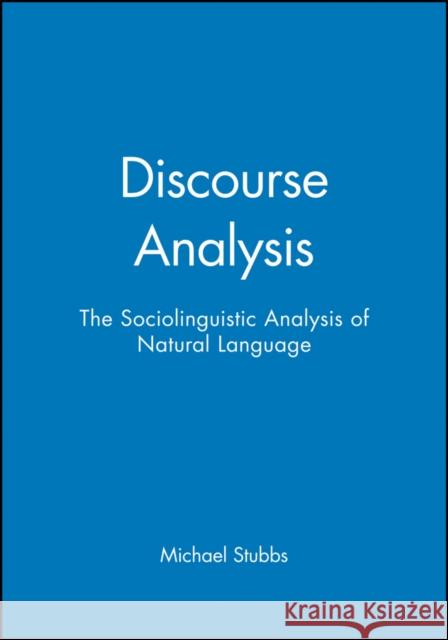
Michael Stubbs;Stubbs
Discourse Analysis: The Sociolinguistic Analysis of Natural Language Stubbs, Michael 9780631127635 John Wiley & Sons - książkaWidoczna okładka, to zdjęcie poglądowe, a rzeczywista szata graficzna może różnić się od prezentowanej.

Discourse Analysis: The Sociolinguistic Analysis of Natural Language

ISBN-13: 9780631127635 / Angielski / Miękka / 1991 / 288 str.

Michael Stubbs;Stubbs
cena 220,98 zł
(netto: 210,46 VAT:  5%)

Najniższa cena z 30 dni: 218,27 zł
Termin realizacji zamówienia:
ok. 30 dni roboczych
Bez gwarancji dostawy przed świętami

Darmowa dostawa!
inne wydania

The study of naturally occurring connected discourse, spoken or written is one of the most promising and rapidly developing areas of linguistics. Traditional linguistics has concentrated on the analysis of single sentence or isolated speech acts. In this important new book Michael Stubbs shows that linguistic concepts can be extended to analyse spontaneous and informal talk in the home, classroom or factory, and, indeed, written narrative.

Using copious examples drawn from recorded conversations, field work observations, experimental data and written texts, he explores such questions as how far discourse structure is comparable to sentence structure; whether it is possible to talk of 'well formed' discourse as one does of 'grammatical' sentences; and whether the relation between question and answer in conversation is syntactic, semantic or pragmatic. He also demonstrates some of the limitations of contemporary linguistics and speech act theory which neglect key aspects of native speaker fluency and communicative competence.

Alhough written from a predominantly linguistic perspective, the book is informed by insights from sociology and anthropology. Theoretical debate is accompanied by discussion of real life implications, particularly for the teacher. A Final Chapter offers clear and practical guidelines on methods of data collection and analysis for the student and researcher; and the book includes a full bibliography and suggestions for further reading.


Kategorie:
Nauka, Literaturoznawstwo
Kategorie BISAC:
Literary Criticism > Semiotics & Theory
Language Arts & Disciplines > Linguistics - Sociolinguistics
Language Arts & Disciplines > Linguistics - Semantics
Wydawca:
John Wiley & Sons
Seria wydawnicza:
Language in Society
Język:
Angielski
ISBN-13:
9780631127635
Rok wydania:
1991
Numer serii:
000012927
Ilość stron:
288
Waga:
0.42 kg
Wymiary:
22.86 x 15.24 x 1.65
Oprawa:
Miękka
Wolumenów:
01
Dodatkowe informacje:
Bibliografia

Editor′s Preface.

Acknowledgements.

Notational Conventions.

Part I: Introduction: .

Discourse Analysis: A Programmatic Introduction.

1. Language, action, knowledge and situation.

2. The Impossibility of Discourse Analysis.

3. Discourse Analysis and Linguistics.

4. Discourse Analysis and Sociolinguistics.

5. Terminology.

6. Idealization.

7. The State of the Art.

8. The Organization of the Book.

Part II: Three Approaches to Discourse Analysis:.

On Speaking Terms: Inspecting Conversational Data:.

9. Discourse Organization.

10. Inspecting Transcribed Data.

11. Some Observations on the Data.

12. Narrative Organisations.

13. Interactional Roles.

14. Discourse Analysis and Interaction.

15. Narrative Structure.

16. Natural Conversation.

17. Native Speaker Fluency.

18. Conclusions.

Data Appendix.

On the Same Wavelength.

19. Some initial Observations.

20. Data Collection.

21. Problems of Perception.

22. Communicative Problems in the Classroom.

23. Sociolinguistics and Language Variation.

24. Language Functions.

25. Metacommunicative Acts.

26. Monitoring Classroom talk.

27. Two Descriptive Rules of Language Use.

28. Limitations on the Analysis.

29. The Hidden Curriculum or Medium as Message.

30. Object Language and Metalanguage.

On a Different Level: Particles, Adverbs and Connectors.

31. Well...

32. Adverbs.

33. Please.

34. Tests for Speech acts.

35. Pragmatic Connectors.

36. Conclusions.

Part III: Exchange Structure:.

A Linguistic Approach to Discourse: Structures and Well–Formedness.

37. A Linguistic Approach to Discourse.

38. Predictability and well–formedness.

39. Phonotactics.

40. Grammaticality.

41. Intuitions about Discourse Sequences.

42. Predictability.

43. Predictability and Idealization.

44. Structure Controls Meaning.

45. Canonical Discourse and Idealization.

46. Analogies.

47. Conclusions.

Initiations and Responses.

48. Questions.

49. Yes–no Questions.

50. X–Questions.

51. An Initial Definition of Exchange.

52. Yes and No.

53. Observational Studies of Yes and No.

54. A–, B– and AB–events.

55. Truth and Certainty.

56. Knowledge and Beliefs.

57. Actives and Passives.

58. Conclusions.

Analysing Exchange Structure.

59. Theory, Methodology and Data.

60. Well–formedness in discourse.

61. Notational conventions.

62. Research on Exchange Structures.

63. Sinclair′s Work on Discourse.

64. Basic Discourse Categories.

65. Analysis of Complete Interchange.

66. Tests for +/– initial.

67. Some Candidate Analysis.

68. Eliciting Informants′ intuitions on Discourse.

69. Concluding Comments.

Part IV: Surface Cohesion and Underlying Coherence: .

Beneath the Surface of Discourse: Indirection in Speech Acts.

70. Austin: Utterances as Actions.

71. Discourse acts and Speech Acts.

72. Austin′s Theory of Speech Acts.

73. Identifying Speech Acts.

74. Speech Acts and Social Roles.

75. Problems for Hearers and Readers.

76. Finding the Answer.

77. Motivating Underlying Acts.

78. Conclusions.

On the Surface of Discourse: Prefaces and Alignments.

79. The Indirection Argument.

80. Limitations on Idealized Data.

81. Formulating Turns at Talk.

82. Prefaces.

Alignmnets.

83. Acknowledge, Accept and Endorse.

84. Conclusion.

Stir Until the Plot Thickens: The Propositional Analysis of Text.

85. A Method for Investigating Narrative Structure.

86. Literacy Competence.

87. Propositions in Stories.

88. The Concepts of Plot and Summary.

89. The Semantics Analysis of Plots.

90. Propositions, Entailments and Presuppositions.

91. Existential presuppositions: or how to tell jokes.

92. Co–reference: One Cat or Two.

93. Entailments and Implications: or how to tell lies.

94. Maxims of Quantity.

95. Implicatures.

96. Summary.

97. The Sociolinguistic Analysis of Literary Language.

98. Prepositional Analysis.

99. Presuppositions.

Part V: Methodology: .

Collecting Conversational Data: Notes on Sociolinguistic Methodology.

100. The Lack of Accepted Procedures in Discourse Analysis.

101. Labov and Sociolinguistic Methodology.

102. Practical Problems.

103. How Much Data?.

104. Theoretical Biases in Recording.

105. Theoretical Biases in Transcription.

106. Field Notes.

107. Theoretical Sampling.

108. Triangulation.

109. The Problem of Perception.

110. An Illustration.

111. Conclusions.

Further Reading.

References.

Name Index.

Subject Index.

Michael Stubbs is Lecturer in Linguistics at the University of Nottingham. He is author of Language, Schools and Classrooms ( 1976) and Lanaguage and Literacy (1980).

The study of naturally occurring connected discourse, spoken or written is one of the most promising and rapidly developing areas of linguistics. Traditional linguistics has concentrated on the analysis of single sentence or isolated speech acts. In this important new book Michael Stubbs shows that linguistic concepts can be extended to analyse spontaneous and informal talk in the home, classroom or factory, and, indeed, written narrative.

Using copious examples drawn from recorded conversations, field work observations, experimental data and written texts, he explores such questions as how far discourse structure is comparable to sentence structure; whether it is possible to talk of ′well formed′ discourse as one does of ′grammatical′ sentences; and whether the relation between question and answer in conversation is syntactic, semantic or pragmatic. He also demonstrates some of the limitations of contemporary linguistics and speech act theory which neglect key aspects of native speaker fluency and communicative competence.

Alhough written from a predominantly linguistic perspective, the book is informed by insights from sociology and anthropology. Theoretical debate is accompanied by discussion of real life implications, particularly for the teacher. A Final Chapter offers clear and practical guidelines on methods of data collection and analysis for the student and researcher; and the book includes a full bibliography and suggestions for further reading.

Stubbs, Michael Michaela Mahlberg is Associate Professor in Englis... więcej >


Udostępnij

Facebook - konto krainaksiazek.pl


Opinie o Krainaksiazek.pl na Opineo.pl

Partner Mybenefit

Krainaksiazek.pl w programie rzetelna firma Krainaksiaze.pl - płatności przez paypal

Czytaj nas na:

Facebook - krainaksiazek.pl
  • książki na zamówienie
  • granty
  • książka na prezent
  • kontakt
  • pomoc
  • opinie
  • regulamin
  • polityka prywatności

Zobacz:

  • Księgarnia czeska

  • Wydawnictwo Książkowe Klimaty

1997-2025 DolnySlask.com Agencja Internetowa

© 1997-2022 krainaksiazek.pl
     
KONTAKT | REGULAMIN | POLITYKA PRYWATNOŚCI | USTAWIENIA PRYWATNOŚCI
Zobacz: Księgarnia Czeska | Wydawnictwo Książkowe Klimaty | Mapa strony | Lista autorów
KrainaKsiazek.PL - Księgarnia Internetowa

Polityka prywatnosci - link
Krainaksiazek.pl - płatnośc Przelewy24
Przechowalnia Przechowalnia




