Signal Analysis: Time, Frequency, Scale, and Structure » książka





Signal Analysis: Time, Frequency, Scale, and Structure
ISBN-13: 9780471234418 / Angielski / Twarda / 2004 / 966 str.
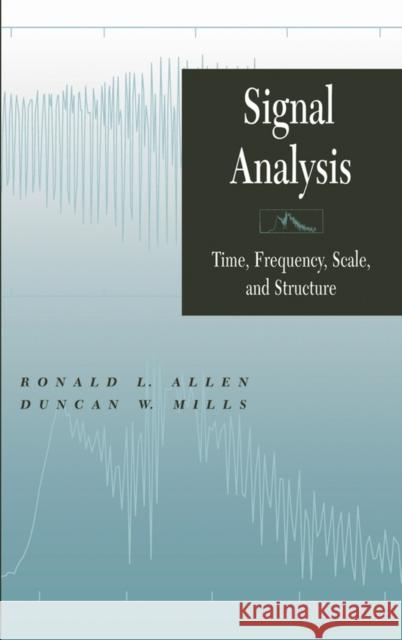
Signal Analysis: Time, Frequency, Scale, and Structure
ISBN-13: 9780471234418 / Angielski / Twarda / 2004 / 966 str.
(netto: 716,18 VAT: 5%)
Najniższa cena z 30 dni: 727,98
ok. 30 dni roboczych.
Darmowa dostawa!
- Offers a well-rounded, mathematical approach to problems in signal interpretation using the latest time, frequency, and mixed-domain methods
- Equally useful as a reference, an up-to-date review, a learning tool, and a resource for signal analysis techniques
- Provides a gradual introduction to the mathematics so that the less mathematically adept reader will not be overwhelmed with instant hard analysis
- Covers Hilbert spaces, complex analysis, distributions, random signals, analog Fourier transforms, and more
Wydanie ilustrowane
Preface.
Acknowledgments.
1 Signals: Analog, Discrete, and Digital.
1.1 Introduction to Signals.
1.1.1 Basic Concepts.
1.1.2 Time–Domain Description of Signals.
1.1.3 Analysis in the Time–Frequency Plane.
1.1.4 Other Domains: Frequency and Scale.
1.2 Analog Signals.
1.2.1 Definitions and Notation.
1.2.2 Examples.
1.2.3 Special Analog Signals.
1.3 Discrete Signals.
1.3.1 Definitions and Notation.
1.3.2 Examples.
1.3.3 Special Discrete Signals.
1.4 Sampling and Interpolation.
1.4.1 Introduction.
1.4.2 Sampling Sinusoidal Signals.
1.4.3 Interpolation.
1.4.4 Cubic Splines.
1.5 Periodic Signals.
1.5.1 Fundamental Period and Frequency.
1.5.2 Discrete Signal Frequency.
1.5.3 Frequency Domain.
1.5.4 Time and Frequency Combined.
1.6 Special Signal Classes.
1.6.1 Basic Classes.
1.6.2 Summable and Integrable Signals.
1.6.3 Finite Energy Signals.
1.6.4 Scale Description.
1.6.5 Scale and Structure.
1.7 Signals and Complex Numbers.
1.7.1 Introduction.
1.7.2 Analytic Functions.
1.7.3 Complex Integration.
1.8 Random Signals and Noise.
1.8.1 Probability Theory.
1.8.2 Random Variables.
1.8.3 Random Signals.
1.9 Summary.
1.9.1 Historical Notes.
1.9.2 Resources.
1.9.3 Looking Forward.
1.9.4 Guide to Problems.
References.
Problems.
2 Discrete Systems and Signal Spaces.
2.1 Operations on Signals.
2.1.1 Operations on Signals and Discrete Systems.
2.1.2 Operations on Systems.
2.1.3 Types of Systems.
2.2 Linear Systems.
2.2.1 Properties.
2.2.2 Decomposition.
2.3 Translation Invariant Systems.
2.4 Convolutional Systems.
2.4.1 Linear, Translation–Invariant Systems.
2.4.2 Systems Defined by Difference Equations.
2.4.3 Convolution Properties.
2.4.4 Application: Echo Cancellation in Digital Telephony.
2.5 The lp Signal Spaces.
2.5.1 lp Signals.
2.5.2 Stable Systems.
2.5.3 Toward Abstract Signal Spaces.
2.5.4 Normed Spaces.
2.5.5 Banach Spaces.
2.6 Inner Product Spaces.
2.6.1 Definitions and Examples.
2.6.2 Norm and Metric.
2.6.3 Orthogonality.
2.7 Hilbert Spaces.
2.7.1 Definitions and Examples.
2.7.2 Decomposition and Direct Sums.
2.7.3 Orthonormal Bases.
2.8 Summary.
References.
Problems.
3 Analog Systems and Signal Spaces.
3.1 Analog Systems.
3.1.1 Operations on Analog Signals.
3.1.2 Extensions to the Analog World.
3.1.3 Cross–Correlation, Autocorrelation, and Convolution.
3.1.4 Miscellaneous Operations.
3.2 Convolution and Analog LTI Systems.
3.2.1 Linearity and Translation–Invariance.
3.2.2 LTI Systems, Impulse Response, and Convolution.
3.2.3 Convolution Properties.
3.2.4 Dirac Delta Properties.
3.2.5 Splines.
3.3 Analog Signal Spaces.
3.3.1 Lp Spaces.
3.3.2 Inner Product and Hilbert Spaces.
3.3.3 Orthonormal Bases.
3.3.4 Frames.
3.4 Modern Integration Theory.
3.4.1 Measure Theory.
3.4.2 Lebesgue Integration.
3.5 Distributions.
3.5.1 From Function to Functional.
3.5.2 From Functional to Distribution.
3.5.3 The Dirac Delta.
3.5.4 Distributions and Convolution.
3.5.5 Distributions as a Limit of a Sequence.
3.6 Summary.
3.6.1 Historical Notes.
3.6.2 Looking Forward.
3.6.3 Guide to Problems.
References.
Problems.
4 Time–Domain Signal Analysis.
4.1 Segmentation.
4.1.1 Basic Concepts.
4.1.2 Examples.
4.1.3 Classification.
4.1.4 Region Merging and Splitting.
4.2 Thresholding.
4.2.1 Global Methods.
4.2.2 Histograms.
4.2.3 Optimal Thresholding.
4.2.4 Local Thresholding.
4.3 Texture.
4.3.1 Statistical Measures.
4.3.2 Spectral Methods.
4.3.3 Structural Approaches.
4.4 Filtering and Enhancement.
4.4.1 Convolutional Smoothing.
4.4.2 Optimal Filtering.
4.4.3 Nonlinear Filters.
4.5 Edge Detection.
4.5.1 Edge Detection on a Simple Step Edge.
4.5.2 Signal Derivatives and Edges.
4.5.3 Conditions for Optimality.
4.5.4 Retrospective.
4.6 Pattern Detection.
4.6.1 Signal Correlation.
4.6.2 Structural Pattern Recognition.
4.6.3 Statistical Pattern Recognition.
4.7 Scale Space.
4.7.1 Signal Shape, Concavity, and Scale.
4.7.2 Gaussian Smoothing.
4.8 Summary.
References.
Problems.
5 Fourier Transforms of Analog Signals.
5.1 Fourier Series.
5.1.1 Exponential Fourier Series.
5.1.2 Fourier Series Convergence.
5.1.3 Trigonometric Fourier Series.
5.2 Fourier Transform.
5.2.1 Motivation and Definition.
5.2.2 Inverse Fourier Transform.
5.2.3 Properties.
5.2.4 Symmetry Properties.
5.3 Extension to L2(R).
5.3.1 Fourier Transforms in L1(R) ∩ L2(R).
5.3.2 Definition.
5.3.3 Isometry.
5.4 Summary.
5.4.1 Historical Notes.
5.4.2 Looking Forward.
References.
Problems.
6 Generalized Fourier Transforms of Analog Signals.
6.1 Distribution Theory and Fourier Transforms.
6.1.1 Examples.
6.1.2 The Generalized Inverse Fourier Transform.
6.1.3 Generalized Transform Properties.
6.2 Generalized Functions and Fourier Series Coefficients.
6.2.1 Dirac Comb: A Fourier Series Expansion.
6.2.2 Evaluating the Fourier Coefficients: Examples.
6.3 Linear Systems in the Frequency Domain.
6.3.1 Convolution Theorem.
6.3.2 Modulation Theorem.
6.4 Introduction to Filters.
6.4.1 Ideal Low–pass Filter.
6.4.2 Ideal High–pass Filter.
6.4.3 Ideal Bandpass Filter.
6.5 Modulation.
6.5.1 Frequency Translation and Amplitude Modulation.
6.5.2 Baseband Signal Recovery.
6.5.3 Angle Modulation.
6.6 Summary.
References.
Problems.
7 Discrete Fourier Transforms.
7.1 Discrete Fourier Transform.
7.1.1 Introduction.
7.1.2 The DFT s Analog Frequency–Domain Roots.
7.1.3 Properties.
7.1.4 Fast Fourier Transform.
7.2 Discrete–Time Fourier Transform.
7.2.1 Introduction.
7.2.2 Properties.
7.2.3 LTI Systems and the DTFT.
7.3 The Sampling Theorem.
7.3.1 Band–Limited Signals.
7.3.2 Recovering Analog Signals from Their Samples.
7.3.3 Reconstruction.
7.3.4 Uncertainty Principle.
7.4 Summary.
References.
Problems.
8 The z–Transform.
8.1 Conceptual Foundations.
8.1.1 Definition and Basic Examples.
8.1.2 Existence.
8.1.3 Properties.
8.2 Inversion Methods.
8.2.1 Contour Integration.
8.2.2 Direct Laurent Series Computation.
8.2.3 Properties and z–Transform Table Lookup.
8.2.4 Application: Systems Governed by Difference Equations.
8.3 Related Transforms.
8.3.1 Chirp z–Transform.
8.3.2 Zak Transform.
8.4 Summary.
8.4.1 Historical Notes.
8.4.2 Guide to Problems.
References.
Problems.
9 Frequency–Domain Signal Analysis.
9.1 Narrowband Signal Analysis.
9.1.1 Single Oscillatory Component: Sinusoidal Signals.
9.1.2 Application: Digital Telephony DTMF.
9.1.3 Filter Frequency Response.
9.1.4 Delay.
9.2 Frequency and Phase Estimation.
9.2.1 Windowing.
9.2.2 Windowing Methods.
9.2.3 Power Spectrum Estimation.
9.2.4 Application: Interferometry.
9.3 Discrete filter design and implementation.
9.3.1 Ideal Filters.
9.3.2 Design Using Window Functions.
9.3.3 Approximation.
9.3.4 Z–Transform Design Techniques.
9.3.5 Low–Pass Filter Design.
9.3.6 Frequency Transformations.
9.3.7 Linear Phase.
9.4 Wideband Signal Analysis.
9.4.1 Chirp Detection.
9.4.2 Speech Analysis.
9.4.3 Problematic Examples.
9.5 Analog Filters.
9.5.1 Introduction.
9.5.2 Basic Low–Pass Filters.
9.5.3 Butterworth.
9.5.4 Chebyshev.
9.5.5 Inverse Chebyshev.
9.5.6 Elliptic Filters.
9.5.7 Application: Optimal Filters.
9.6 Specialized Frequency–Domain Techniques.
9.6.1 Chirp–z Transform Application.
9.6.2 Hilbert Transform.
9.6.3 Perfect Reconstruction Filter Banks.
9.7 Summary.
References.
Problems.
10 Time–Frequency Signal Transforms.
10.1 Gabor Transforms.
10.1.1 Introduction.
10.1.2 Interpretations.
10.1.3 Gabor Elementary Functions.
10.1.4 Inversion.
10.1.5 Applications.
10.1.6 Properties.
10.2 Short–Time Fourier Transforms.
10.2.1 Window Functions.
10.2.2 Transforming with a General Window.
10.2.3 Properties.
10.2.4 Time–Frequency Localization.
10.3 Discretization.
10.3.1 Transforming Discrete Signals.
10.3.2 Sampling the Short–Time Fourier Transform.
10.3.3 Extracting Signal Structure.
10.3.4 A Fundamental Limitation.
10.3.5 Frames of Windowed Fourier Atoms.
10.3.6 Status of Gabor s Problem.
10.4 Quadratic Time–Frequency Transforms.
10.4.1 Spectrogram.
10.4.2 Wigner Ville Distribution.
10.4.3 Ambiguity Function.
10.4.4 Cross–Term Problems.
10.4.5 Kernel Construction Method.
10.5 The Balian Low Theorem.
10.5.1 Orthonormal Basis Decomposition.
10.5.2 Frame Decomposition.
10.5.3 Avoiding the Balian Low Trap.
10.6 Summary.
10.6.1 Historical Notes.
10.6.2 Resources.
10.6.3 Looking Forward.
References.
Problems.
11 Time–Scale Signal Transforms.
11.1 Signal Scale.
11.2 Continuous Wavelet Transforms.
11.2.1 An Unlikely Discovery.
11.2.2 Basic Theory.
11.2.3 Examples.
11.3 Frames.
11.3.1 Discretization.
11.3.2 Conditions on Wavelet Frames.
11.3.3 Constructing Wavelet Frames.
11.3.4 Better Localization.
11.4 Multiresolution Analysis and Orthogonal Wavelets.
11.4.1 Multiresolution Analysis.
11.4.2 Scaling Function.
11.4.3 Discrete Low–Pass Filter.
11.4.4 Orthonormal Wavelet.
11.5 Summary.
References.
Problems.
12 Mixed–Domain Signal Analysis.
12.1 Wavelet Methods for Signal Structure.
12.1.1 Discrete Wavelet Transform.
12.1.2 Wavelet Pyramid Decomposition.
12.1.3 Application: Multiresolution Shape Recognition.
12.2 Mixed–Domain Signal Processing.
12.2.1 Filtering Methods.
12.2.2 Enhancement Techniques.
12.3 Biophysical Applications.
12.3.1 David Marr s Program.
12.3.2 Psychophysics.
12.4 Discovering Signal Structure.
12.4.1 Edge Detection.
12.4.2 Local Frequency Detection.
12.4.3 Texture Analysis.
12.5 Pattern Recognition Networks.
12.5.1 Coarse–to–Fine Methods.
12.5.2 Pattern Recognition Networks.
12.5.3 Neural Networks.
12.5.4 Application: Process Control.
12.6 Signal Modeling and Matching.
12.6.1 Hidden Markov Models.
12.6.2 Matching Pursuit.
12.6.3 Applications.
12.7 Afterword.
References.
Problems.
Index.
RONALD L. ALLEN received his BA in mathematics from the University of California, Berkeley in 1973, his MA in mathematics from the University of California, Los Angeles in 1975, and his MS and PhD in Computer Science from the University of Texas at Arlington in 1990 and 1993, respectively.
DUNCAN W. MILLS received his BA in Physics from Wesleyan University, his MS in Electrical Engineering from George Washington University, and his PhD in Electrical Engineering from University of Texas at Dallas in 1992.
Signal analysis from concept to application
Signal analysis, a method of arriving at a structural description of a signal so that later high–level algorithms can interpret its content, is a growing field with an increasing number of applications. Signal Analysis: Time, Frequency, Scale, and Structure opens a window into the practice of signal analysis by providing a gradual yet thorough introduction to the theory behind signal analysis as well as the abstract mathematics and functional analysis which may be new to many readers.
Making the material accessible for readers of different levels of mathematical background, the authors clarify the basic concepts and types of signals and slowly build up to mastering the mathematics of Hilbert spaces, complex analysis, distributions, random signals, and analog Fourier transforms. Chapters cover:
- Concepts of analog, discrete, and digital signals
- Discrete systems and signal spaces, including linear and convolutional systems and lp signal spaces
- Time domain signal analysis including segmentation and thresholding, filtering and enhancement, and edge and pattern detection
- Continuous, discrete, and generalized Fourier transforms
- The z–transform, time–frequency and time–scale signal transforms
- Frequency domain and mixed–domain signal analysis
Suitable as a professional reference, up–to–date review for practitioners, and a resource of signal analysis techniques, Signal Analysis: Time, Frequency, Scale, and Structure serves up a well–rounded, mathematical approach to problems in signal interpretation using the latest time, frequency, and mixed–domain methods.




Czytaj nas na:
1997-2026 DolnySlask.com Agencja Internetowa
KrainaKsiazek.PL - Księgarnia Internetowa


