• Wyszukiwanie zaawansowane
  • Kategorie
  • Kategorie BISAC
  • Książki na zamówienie
  • Promocje
  • Granty
  • Książka na prezent
  • Opinie
  • Pomoc
  • Załóż konto
  • Zaloguj się

The Map Reader : Theories of Mapping Practice and Cartographic Representation » książka


zaloguj się | załóż konto
Logo Krainaksiazek.pl

koszyk

konto

szukaj
topmenu
Księgarnia internetowa
Szukaj
Książki na zamówienie
Promocje
Granty
Książka na prezent
Moje konto
Pomoc
 
 
Wyszukiwanie zaawansowane
Pusty koszyk
Bezpłatna dostawa dla zamówień powyżej 20 złBezpłatna dostawa dla zamówień powyżej 20 zł

Kategorie główne

• Nauka
 [2946600]
• Literatura piękna
 [1856966]

  więcej...
• Turystyka
 [72221]
• Informatyka
 [151456]
• Komiksy
 [35826]
• Encyklopedie
 [23190]
• Dziecięca
 [619653]
• Hobby
 [140543]
• AudioBooki
 [1577]
• Literatura faktu
 [228355]
• Muzyka CD
 [410]
• Słowniki
 [2874]
• Inne
 [445822]
• Kalendarze
 [1744]
• Podręczniki
 [167141]
• Poradniki
 [482898]
• Religia
 [510455]
• Czasopisma
 [526]
• Sport
 [61590]
• Sztuka
 [243598]
• CD, DVD, Video
 [3423]
• Technologie
 [219201]
• Zdrowie
 [101638]
• Książkowe Klimaty
 [124]
• Zabawki
 [2473]
• Puzzle, gry
 [3898]
• Literatura w języku ukraińskim
 [254]
• Art. papiernicze i szkolne
 [8170]
Kategorie szczegółowe BISAC

The Map Reader : Theories of Mapping Practice and Cartographic Representation

ISBN-13: 9780470742839 / Angielski / Twarda / 2011 / 504 str.
Martin Dodge
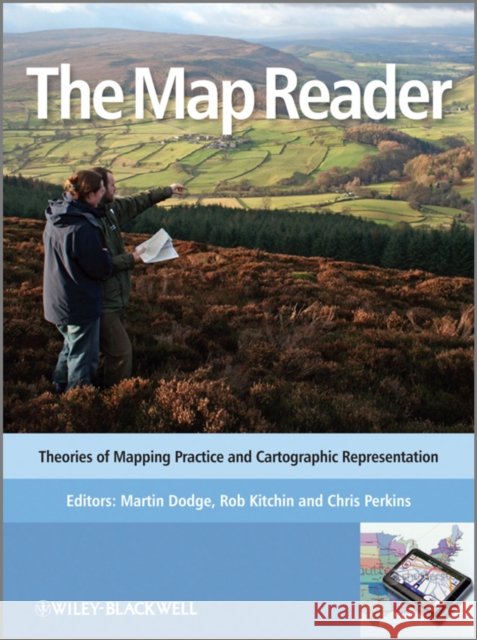
The Map Reader : Theories of Mapping Practice and Cartographic Representation Martin Dodge 9780470742839  - książkaWidoczna okładka, to zdjęcie poglądowe, a rzeczywista szata graficzna może różnić się od prezentowanej.

The Map Reader : Theories of Mapping Practice and Cartographic Representation

ISBN-13: 9780470742839 / Angielski / Twarda / 2011 / 504 str.

Martin Dodge
cena 692,76 zł
(netto: 659,77 VAT:  5%)

Najniższa cena z 30 dni: 532,02 zł
Termin realizacji zamówienia:
ok. 16-18 dni roboczych
Bez gwarancji dostawy przed świętami

Darmowa dostawa!

WINNER OF THE CANTEMIR PRIZE 2012 awarded by the Berendel Foundation The Map Reader brings together, for the first time, classic and hard-to-find articles on mapping. This book provides a wide-ranging and coherent edited compendium of key scholarly writing about the changing nature of cartography over the last half century. The editorial selection of fifty-four theoretical and thought provoking texts demonstrates how cartography works as a powerful representational form and explores how different mapping practices have been conceptualised in particular scholarly contexts. Themes covered include paradigms, politics, people, aesthetics and technology. Original interpretative essays set the literature into intellectual context within these themes. Excerpts are drawn from leading scholars and researchers in a range of cognate fields including: Cartography, Geography, Anthropology, Architecture, Engineering, Computer Science and Graphic Design. The Map Reader provides a new unique single source reference to the essential literature in the cartographic field:

  • more than fifty specially edited excerpts from key, classic articles and monographs
  • critical introductions by experienced experts in the field
  • focused coverage of key mapping practices, techniques and ideas
  • a valuable resource suited to a broad spectrum of researchers and students working in cartography and GIScience, geography, the social sciences, media studies, and visual arts
  • full page colour illustrations of significant maps as provocative visual 'think-pieces'
  • fully indexed, clearly structured and accessible ways into a fast changing field of cartographic research
Co-edited by Martin Dodge and Chris Perkins, Senior Lecturers in Human Geography in the School of Environment and Development, the University of Manchester; and Rob Kitchin, Professor of Geography, National University of Ireland, Maynooth.

Kategorie:
Nauka
Kategorie BISAC:
Reference > Atlases, Gazetteers & Maps (see also Travel - Maps & Road Atlases)
Technology & Engineering > Remote Sensing & Geographic Information Systems
Język:
Angielski
ISBN-13:
9780470742839
Rok wydania:
2011
Ilość stron:
504
Waga:
1.31 kg
Wymiary:
26.2 x 20.4 x 3.4
Oprawa:
Twarda
Dodatkowe informacje:
Bibliografia

The Map Reader feels like a rich investigation and compilation, adding to the literature of this relatively overlooked visual culture and bringing together in one place a valuable scholarly documentation and discussion of this important visual medium, along with some suggestion of the enormous potential for where it s going.   (Landscape Ecology, 1 March 2013)

"It is compulsory reading for students, academics and lay readers interested in understanding the appeal and power of maps . It deserves a wide reading audience."  (Int. J. Environment and Pollution, 1 October 2013)

"But for anyone who wants to get the most out of a map, whatever medium it is in, it is fascinating. It is a text–book for map readers, written by map–makers". (Law Society Journal, 1 October 2011)

"I highly recommend the landmark anthology The Map Reader: Theories of Mapping Practice and Cartographic Representation edited by Martin Dodge, Rob Kitchin, and Chris Perkins, to any students, researchers, and interested non–professionals in the areas of cartography, mapping technology, GIScience, social sciences, the media, the visual arts, and industry who are seeking a complete resource on the topic of map making. The articles cover every aspect of this rapidly changing field, written by leading scholars in many very diverse disciplines." (Blog Business World, 2 October 2011)

"Written as a comprehensive guide to cover all of these disciplines The Map Reader ensures that the most important cartographic ideas are made available to researchers, students and cartography enthusiast alike." (PhysOrg.com, 25 May 2011)

The Editors.

Preface.

Acknowledgements.

Colour Plate One: Cartographic Production.

Section One Conceptualising Mapping.

1.1 Introductory Essay: Conceptualising Mapping (Rob Kitchin, Martin Dodge and Chris Perkins).

1.2 General Theory, from Semiology of Graphics (Jacques Bertin).

1.3 On Maps and Mapping, from The Nature of Maps: Essays Toward Understanding Maps and Mapping (Arthur H. Robinson and Barbara B. Petchenik).

1.4 The Science of Cartography and its Essential Processes (Joel L. Morrison).

1.5 Analytical Cartography (Waldo R. Tobler).

1.6 Cartographic Communication (Christopher Board).

1.7 Design on Signs / Myth and Meaning in Maps (Denis Wood and John Fels).

1.8 Deconstructing the Map (J.B. Harley).

1.9 Drawing Things Together (Bruno Latour).

1.10 Cartography Without ′Progress′: Reinterpreting the Nature and Historical Development of Mapmaking (Matthew H. Edney).

1.11 Exploratory Cartographic Visualisation: Advancing the Agenda (Alan M. MacEachren and Menno–Jan Kraak).

1.12 The Agency of Mapping: Speculation, Critique and Invention (James Corner).

1.13 Beyond the ′Binaries′: A Methodological Intervention for Interrogating Maps as Representational Practices (Vincent J. Del Casino Jr. and Stephen P. Hanna).

1.14 Rethinking Maps (Rob Kitchin and Martin Dodge).

Colour Plate Two: Mapping the Internet.

Section Two Technologies of Mapping.

2.1 Introductory Essay: Technologies of Mapping (Martin Dodge, Rob Kitchin and Chris Perkins).

2.2 A Century of Cartographic Change, from Technological Transition in Cartography (Mark S. Monmonier).

2.3 Manufacturing Metaphors: Public Cartography, the Market, and Democracy (Patrick H. McHaffie).

2.4 Maps and Mapping Technologies of the Persian Gulf War (Keith C. Clarke).

2.5 Automation and Cartography (Waldo R. Tobler)

2.6 Cartographic Futures on a Digital Earth (Michael F. Goodchild).

2.7 Cartography and Geographic Information Systems (Phillip C. Muehrcke).

2.8 Remote Sensing of Urban/Suburban Infrastructure and Socio–Economic Attributes (John R. Jensen and Dave C. Cowen).

2.9 Emergence of Map Projections, from Flattening the Earth: Two Thousand Years of Map Projections (John P. Synder).

2.10 Mobile Mapping: An Emerging Technology for Spatial Data Acquisition (Rongxing Li).

2.11 Extending the Map Metaphor Using Web Delivered Multimedia (William Cartwright).

2.12 Imaging the World: The State of Online Mapping (Tom Geller).

Colour Plate Three: Pictorial Mapping.

Section Three Cartographic Aesthetics and Map Design.

3.1 Introductory Essay: Cartographic Aesthetics and Map Design (Chris Perkins, Martin Dodge and Rob Kitchin).

3.2 Interplay of Elements, from Cartographic Relief Presentation (Eduard Imhof).

3.3 Cartography as a Visual Technique, from The Look of Maps (Arthur H. Robinson).

3.4 Generalisation in Statistical Mapping (George F. Jenks).

3.5 Strategies for the Visualisation of Geographic Time–Series Data (Mark Monmonier).

3.6 The Roles of Maps, from Some Truth with Maps: A Primer on Symbolization and Design (Alan M. MacEachren).

3.7 Area Cartograms: Their Use and Creation (Daniel Dorling).

3.8 ColorBrewer.org: An Online Tool for Selecting Colour Schemes for Maps (Mark Harrower and Cynthia A. Brewer).

3.9 Maps, Mapping, Modernity: Art and Cartography in the Twentieth Century (Denis Cosgrove).

3.10 Affective Geovisualisations (Stuart Aitken and James Craine).

3.11 Egocentric Design of Map–Based Mobile Services (Liqiu Meng).

3.12 The Geographic Beauty of a Photographic Archive (Jason Dykes and Jo Wood).

Colour Plate Four: Visualising Cartographic Colour Schemes and Mapping Spatial Information Space.

Section Four Cognition and Cultures of Mapping.

4.1 Introductory Essay: Cognition and Cultures of Mapping (Chris Perkins, Rob Kitchin and Martin Dodge).

4.2 Map Makers are Human: Comments on the Subjective in Maps (John K. Wright).

4.3 Cognitive Maps and Spatial Behaviour: Process and Products (Roger M. Downs and David Stea).

4.4 Natural Mapping (James M. Blaut).

4.5 The Map as Biography: Thoughts on Ordnance Survey Map, Six–Inch Sheet Devonshire CIX, SE, Newton Abbot (J.B. Harley).

4.6 Reading Maps (Eileen Reeves).

4.7 Mapping Reeds and Reading Maps: The Politics of Representation in Lake Titicaca (Benjamin S. Orlove).

4.8 Refiguring Geography: Parish Maps of Common Ground (David Crouch and David Matless).

4.9 Understanding and Learning Maps (Robert Lloyd).

4.10 Citizens as Sensors: The World of Volunteered Geography (Michael F. Goodchild).

4.11 Usability Evaluation of Web Mapping Sites (Annu–Maaria Nivala, Stephen Brewster and L. Tiina Sarjakoski)

Colour Plate Five: Visualising the Efforts of Volunteer Cartographers.

Section Five Power and Politics of Mapping.

5.1 Introductory Essay: Power and Politics of Mapping (Rob Kitchin, Martin Dodge and Chris Perkins).

5.2 The Time and Space of the Enlightenment Project, from The Condition of Postmodernity (David Harvey).

5.3 Texts, Hermeneutics and Propaganda Maps (John Pickles).

5.4 Mapping: A New Technology of Space; Geo–Body, from Siam Mapped: A History of the Geo–Body of a Nation (Thongchai Winichakul).

5.5 First Principles of a Literary Cartography, from Territorial Disputes: Maps and Mapping Strategies in Contemporary Canadian and Australian Fiction (Graham Huggan).

5.6 Whose Woods are These? Counter–Mapping Forest Territories in Kalimantan, Indonesia (Nancy Lee Peluso).

5.7 A Map that Roared and an Original Atlas: Canada, Cartography, and the Narration of Nation (Matthew Sparke).

5.8 Cartographic Rationality and the Politics of Geosurveillance and Security (Jeremy W. Crampton).

5.9 Affecting Geospatial Technologies: Toward a Feminist Politics of Emotion (Mei–Po Kwan).

5.10 Queering the Map: The Productive Tensions of Colliding Epistemologies (Michael Brown and Larry Knopp).

5.11 Mapping the Digital Empire: Google Earth and the Process of Postmodern Cartography (Jason Farman).

Colour Plate Six: Cartographies of Protest.

Index.

The Map Reader brings together, for the first time, classic and hard–to–find articles on mapping. Providing a wide–ranging and coherent edited compendium of key scholarly writing about the changing nature of cartography over the last half century. The editorial selection of fifty–five theoretical and thought provoking texts demonstrates how cartography works as a powerful representational form and explores how different mapping practices have been conceptualized in particular scholarly contexts.

Themes covered include paradigms, politics, people, aesthetics and technology. Original interpretative essays set the literature into intellectual context within these themes. Excerpts are drawn from leading scholars and researchers in a range of cognate fields including: Cartography, Geography, Anthropology, Architecture, Engineering, Computer Science and Graphic Design.

The Map Reader provides a new unique single source reference to the essential literature in the cartographic field:

  • More than fifty specially edited excerpts from key, classic articles and monographs
  • Critical introductions by experienced experts in the field
  • Focused coverage of key mapping practices, techniques and ideas
  • A valuable resource suited to a broad spectrum of researchers and students working in cartography and GIScience, geography, the social sciences, media studies, and visual arts
  • Full page colour illustrations of significant maps as provocative visual think–pieces
  • Fully indexed, clearly structured and accessible ways into a fast changing field of cartographic research




Udostępnij

Facebook - konto krainaksiazek.pl


Opinie o Krainaksiazek.pl na Opineo.pl

Partner Mybenefit

Krainaksiazek.pl w programie rzetelna firma Krainaksiaze.pl - płatności przez paypal

Czytaj nas na:

Facebook - krainaksiazek.pl
  • książki na zamówienie
  • granty
  • książka na prezent
  • kontakt
  • pomoc
  • opinie
  • regulamin
  • polityka prywatności

Zobacz:

  • Księgarnia czeska

  • Wydawnictwo Książkowe Klimaty

1997-2025 DolnySlask.com Agencja Internetowa

© 1997-2022 krainaksiazek.pl
     
KONTAKT | REGULAMIN | POLITYKA PRYWATNOŚCI | USTAWIENIA PRYWATNOŚCI
Zobacz: Księgarnia Czeska | Wydawnictwo Książkowe Klimaty | Mapa strony | Lista autorów
KrainaKsiazek.PL - Księgarnia Internetowa

Polityka prywatnosci - link
Krainaksiazek.pl - płatnośc Przelewy24
Przechowalnia Przechowalnia



