• Wyszukiwanie zaawansowane
  • Kategorie
  • Kategorie BISAC
  • Książki na zamówienie
  • Promocje
  • Granty
  • Książka na prezent
  • Opinie
  • Pomoc
  • Załóż konto
  • Zaloguj się

introduction to c++ for financial engineers: an object-oriented approach » książka

zaloguj się | załóż konto
Logo Krainaksiazek.pl

koszyk

konto

szukaj
topmenu
Księgarnia internetowa
Szukaj
Książki na zamówienie
Promocje
Granty
Książka na prezent
Moje konto
Pomoc
 
 
Wyszukiwanie zaawansowane
Pusty koszyk
Bezpłatna dostawa dla zamówień powyżej 20 złBezpłatna dostawa dla zamówień powyżej 20 zł

Kategorie główne

• Nauka
 [2950560]
• Literatura piękna
 [1849509]

  więcej...
• Turystyka
 [71097]
• Informatyka
 [151150]
• Komiksy
 [35848]
• Encyklopedie
 [23178]
• Dziecięca
 [617388]
• Hobby
 [139064]
• AudioBooki
 [1657]
• Literatura faktu
 [228597]
• Muzyka CD
 [383]
• Słowniki
 [2855]
• Inne
 [445295]
• Kalendarze
 [1464]
• Podręczniki
 [167547]
• Poradniki
 [480102]
• Religia
 [510749]
• Czasopisma
 [516]
• Sport
 [61293]
• Sztuka
 [243352]
• CD, DVD, Video
 [3414]
• Technologie
 [219456]
• Zdrowie
 [101002]
• Książkowe Klimaty
 [124]
• Zabawki
 [2311]
• Puzzle, gry
 [3459]
• Literatura w języku ukraińskim
 [254]
• Art. papiernicze i szkolne
 [8079]
Kategorie szczegółowe BISAC

introduction to c++ for financial engineers: an object-oriented approach

ISBN-13: 9780470015384 / Angielski / Twarda / 2006 / 438 str.
Duffy, Daniel J.
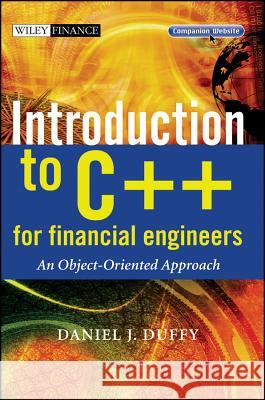
introduction to c++ for financial engineers: an object-oriented approach  Duffy, Daniel J. 9780470015384  - książkaWidoczna okładka, to zdjęcie poglądowe, a rzeczywista szata graficzna może różnić się od prezentowanej.

introduction to c++ for financial engineers: an object-oriented approach

ISBN-13: 9780470015384 / Angielski / Twarda / 2006 / 438 str.

Duffy, Daniel J.
cena 398,80
(netto: 379,81 VAT:  5%)

Najniższa cena z 30 dni: 396,34
Termin realizacji zamówienia:
ok. 30 dni roboczych
Dostawa w 2026 r.

Darmowa dostawa!

This book introduces the reader to the C++ programming language and how to use it to write applications in quantitative finance (QF) and related areas. No previous knowledge of C or C++ is required -- experience with VBA, Matlab or other programming language is sufficient. The book adopts an incremental approach; starting from basic principles then moving on to advanced complex techniques and then to real-life applications in financial engineering. There are five major parts in the book:

  • C++ fundamentals and object-oriented thinking in QF
  • Advanced object-oriented features such as inheritance and polymorphism
  • Template programming and the Standard Template Library (STL)
  • An introduction to GOF design patterns and their applications in QF Applications
The kinds of applications include binomial and trinomial methods, Monte Carlo simulation, advanced trees, partial differential equations and finite difference methods. This book includes a companion website with all source code and many useful C++ classes that you can use in your own applications. Examples, test cases and applications are directly relevant to QF. This book is the perfect companion to Daniel J. Duffy's book Financial Instrument Pricing using C++ (Wiley 2004, 0470855096 / 9780470021620)

Kategorie:
Nauka, Ekonomia i biznes
Kategorie BISAC:
Business & Economics > Finance - General
Computers > Languages - General
Język:
Angielski
ISBN-13:
9780470015384
Rok wydania:
2006
Ilość stron:
438
Waga:
0.99 kg
Wymiary:
24.54 x 17.42 x 3.15
Oprawa:
Twarda
Wolumenów:
01
Dodatkowe informacje:
Bibliografia
Obwoluta
Wydanie ilustrowane

0 Goals of this Book and Global Overview 1

PART I C++ ESSENTIAL SKILLS 5

1 Introduction to C++ and Quantitative Finance 7

2 The Mechanics of C++: from Source Code to a Running Program 15

3 C++ Fundamentals and My First Option Class 31

4 Creating Robust Classes 49

5 Operator Overloading in C++ 63

6 Memory Management in C++ 79

7 Functions, Namespaces and Introduction to Inheritance 93

8 Advanced Inheritance and Payoff Class Hierarchies 113

9 Run–Time Behaviour in C++ 133

10 An Introduction to C++ Templates 153

PART II DATA STRUCTURES, TEMPLATES AND PATTERNS 167

11 Introduction to Generic Data Structures and Standard Template Library (STL) 169

12 Creating Simpler Interfaces to STL for QF Applications 187

13 Data Structures for Financial Engineering Applications 203

14 An Introduction to Design Patterns 223

PART III QF APPLICATIONS 243

15 Programming the Binomial Method in C++ 245

16 Implementing One–Factor Black Scholes in C++ 265

17 Two–Factor Option Pricing: Basket and Other Multi–Asset Options 283

18 Useful C++ Classes for Numerical Analysis Applications in Finance 305

19 Other Numerical Methods in Quantitative Finance 315

20 The Monte Carlo Method Theory and C++ Frameworks 327
Dr. Joerg Kieritz and Daniel J. Duffy

21 Skills Development: from White Belt to Black Belt 345

21.1 Introduction and objectives 345

PART IV BACKGROUND INFORMATION 351

22 Basic C Survival Guide 353

23 Advanced C Syntax 363

24 Datasim Visualisation Package in Excel: Drivers and Mechanisms 373

25 Motivating COM and Emulation in C++ 391

26 COM Fundamentals 401

References 407

Index 409

DANIEL J. DUFFY has been involved in software development projects using C++ and object–oriented design techniques since 1988. He organized the first C++ course in the Netherlands in 1989 and has worked on a variety of C++ projects in areas such as computer graphics, optical technology, process control and quantitative finance systems. In 1993 he worked on an early version of a large object–oriented system for derivatives’ pricing and hedging models. He is designer/trainer and has trained mote than 2000 C++ developers in recent years.
A companion book to the current one is "Financial instrument pricing using C++" (Wiley 2004). Since 1996 he has written seven books on object–oriented design and programming. Daniel Duffy has a Phd in Numerical Analysis from Trinity College Dublin. He lives in the Netherlands with his wife Ilona and son Brendan.
He can be contacted at dduffy@datasim.nl

The object–oriented programming language C++ is the de facto standard for developing real–life applications for Quantitative Finance and Financial Engineering. This language was designed by Dr. Bjarne Stroustup in the early 1990’s and it has become one of the most popular and robust languages for many important areas such as medical systems, computer graphics, telecommunications and in application areas where performance, accuracy and interoperability issues play a key role. The general expectation is that its importance will grow in the coming years.

C++ has also become the de facto standard for quant development and analysis. Knowledge of C++ is mandatory for many openings and job positions in Quantitative Finance. This book is the first book that discusses many of the issues that you need to know in order to be able to design and implement real–world applications. We focus on a number of critical topics:

  • Learning the essential syntax of C++ (′getting the fundamentals right′)
  • Designing and implementing generic data structures using STL
  • Numerous applications (lattices, finite difference, Monte Carlo, etc)
  • Libraries, design patterns (GOF, POSA) and reusable software frameworks
  • Introduction to COM and C++ to Excel interoperability

Each chapter deals with one major topic. Furthermore, each chapter builds only on the results of the chapters preceding it, so that we keep the amount of forward referencing to a minimum. We discuss all the syntax that is discussed in the IT books and we apply it to QF applications. This book is self–contained and we advise its use in combination with the well–known standard reference work by Dr. Stroustrup.

Last, but not least, each chapter concludes with exercises and projects to test what you learned in that chapter. The exercises are based on the tactic: ′get it working, then get it right, then get it optimised′. Furthermore, these exercises will also hopefully prepare you for your job interviews!

Included with the book is a companion website with all source code, including working code for lattice, finite difference and Monte Carlo methods for one–factor and two–factor pricing models as well as an easy–to–use C++ visualization package to help you examine the output from these numerical methods.


Udostępnij

Facebook - konto krainaksiazek.pl


Opinie o Krainaksiazek.pl na Opineo.pl

Partner Mybenefit

Krainaksiazek.pl w programie rzetelna firma Krainaksiaze.pl - płatności przez paypal

Czytaj nas na:

Facebook - krainaksiazek.pl
  • książki na zamówienie
  • granty
  • książka na prezent
  • kontakt
  • pomoc
  • opinie
  • regulamin
  • polityka prywatności

Zobacz:

  • Księgarnia czeska

  • Wydawnictwo Książkowe Klimaty

1997-2025 DolnySlask.com Agencja Internetowa

© 1997-2022 krainaksiazek.pl
     
KONTAKT | REGULAMIN | POLITYKA PRYWATNOŚCI | USTAWIENIA PRYWATNOŚCI
Zobacz: Księgarnia Czeska | Wydawnictwo Książkowe Klimaty | Mapa strony | Lista autorów
KrainaKsiazek.PL - Księgarnia Internetowa

Polityka prywatnosci - link
Krainaksiazek.pl - płatnośc Przelewy24
Przechowalnia Przechowalnia







