• Wyszukiwanie zaawansowane
  • Kategorie
  • Kategorie BISAC
  • Książki na zamówienie
  • Promocje
  • Granty
  • Książka na prezent
  • Opinie
  • Pomoc
  • Załóż konto
  • Zaloguj się

Random and Quasi-Random Point Sets » książka


zaloguj się | załóż konto
Logo Krainaksiazek.pl

koszyk

konto

szukaj
topmenu
Księgarnia internetowa
Szukaj
Książki na zamówienie
Promocje
Granty
Książka na prezent
Moje konto
Pomoc
 
 
Wyszukiwanie zaawansowane
Pusty koszyk
Bezpłatna dostawa dla zamówień powyżej 20 złBezpłatna dostawa dla zamówień powyżej 20 zł

Kategorie główne

• Nauka
 [2950560]
• Literatura piękna
 [1849509]

  więcej...
• Turystyka
 [71097]
• Informatyka
 [151150]
• Komiksy
 [35848]
• Encyklopedie
 [23178]
• Dziecięca
 [617388]
• Hobby
 [139064]
• AudioBooki
 [1657]
• Literatura faktu
 [228597]
• Muzyka CD
 [383]
• Słowniki
 [2855]
• Inne
 [445295]
• Kalendarze
 [1464]
• Podręczniki
 [167547]
• Poradniki
 [480102]
• Religia
 [510749]
• Czasopisma
 [516]
• Sport
 [61293]
• Sztuka
 [243352]
• CD, DVD, Video
 [3414]
• Technologie
 [219456]
• Zdrowie
 [101002]
• Książkowe Klimaty
 [124]
• Zabawki
 [2311]
• Puzzle, gry
 [3459]
• Literatura w języku ukraińskim
 [254]
• Art. papiernicze i szkolne
 [8079]
Kategorie szczegółowe BISAC

Random and Quasi-Random Point Sets

ISBN-13: 9780387985541 / Angielski / Miękka / 1998 / 334 str.
Peter Hellekalek; Gerhard Larcher; K. Krickeberg
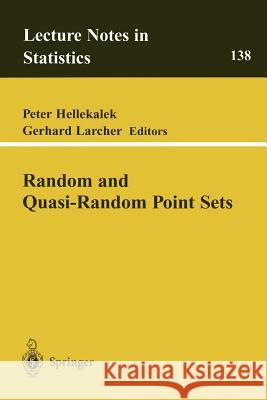
Random and Quasi-Random Point Sets Peter Hellekalek Gerhard Larcher K. Krickeberg 9780387985541 Springer - książkaWidoczna okładka, to zdjęcie poglądowe, a rzeczywista szata graficzna może różnić się od prezentowanej.

Random and Quasi-Random Point Sets

ISBN-13: 9780387985541 / Angielski / Miękka / 1998 / 334 str.

Peter Hellekalek; Gerhard Larcher; K. Krickeberg
cena 402,53
(netto: 383,36 VAT:  5%)

Najniższa cena z 30 dni: 385,52
Termin realizacji zamówienia:
ok. 22 dni roboczych
Dostawa w 2026 r.

Darmowa dostawa!

This volume is a collection of survey papers on recent developments in the fields of quasi-Monte Carlo methods and uniform random number generation. We will cover a broad spectrum of questions, from advanced metric number theory to pricing financial derivatives. The Monte Carlo method is one of the most important tools of system modeling. Deterministic algorithms, so-called uniform random number gen erators, are used to produce the input for the model systems on computers. Such generators are assessed by theoretical ("a priori") and by empirical tests. In the a priori analysis, we study figures of merit that measure the uniformity of certain high-dimensional "random" point sets. The degree of uniformity is strongly related to the degree of correlations within the random numbers. The quasi-Monte Carlo approach aims at improving the rate of conver gence in the Monte Carlo method by number-theoretic techniques. It yields deterministic bounds for the approximation error. The main mathematical tool here are so-called low-discrepancy sequences. These "quasi-random" points are produced by deterministic algorithms and should be as "super" uniformly distributed as possible. Hence, both in uniform random number generation and in quasi-Monte Carlo methods, we study the uniformity of deterministically generated point sets in high dimensions. By a (common) abuse oflanguage, one speaks of random and quasi-random point sets. The central questions treated in this book are (i) how to generate, (ii) how to analyze, and (iii) how to apply such high-dimensional point sets."


Kategorie:
Nauka, Matematyka
Kategorie BISAC:
Mathematics > Prawdopodobieństwo i statystyka
Wydawca:
Springer
Seria wydawnicza:
Lecture Notes in Statistics
Język:
Angielski
ISBN-13:
9780387985541
Rok wydania:
1998
Wydanie:
Softcover Repri
Numer serii:
000013119
Ilość stron:
334
Waga:
1.08 kg
Wymiary:
23.5 x 15.5
Oprawa:
Miękka
Wolumenów:
01
Dodatkowe informacje:
Bibliografia
Wydanie ilustrowane

From Probabilistic Diophantine Approximation to Quadratic Fields.- 1 Part I: Super Irregularity.- 2 Part II: Probabilistic Diophantine Approximation.- 2.1 Local Case: Inhomogeneous Pell Inequalities - Hyperbolas.- 2.2 Beyond Quadratic Irrationals.- 2.3 Global Case: Lattice Points in Tilted Rectangles.- 2.4 Simultaneous Case.- 3 Part III: Quadratic Fields and Continued Fractions.- 3.1 Cesaro Mean of % MathType!MTEF!2!1!+- % feaagCart1ev2aaatCvAUfeBSjuyZL2yd9gzLbvyNv2CaerbuLwBLn % hiov2DGi1BTfMBaeXatLxBI9gBaerbd9wDYLwzYbItLDharqqtubsr % 4rNCHbGeaGqiVu0Je9sqqrpepC0xbbL8F4rqqrFfpeea0xe9Lq-Jc9 % vqaqpepm0xbba9pwe9Q8fs0-yqaqpepae9pg0FirpepeKkFr0xfr-x % fr-xb9adbaqaaeGaciGaaiaabeqaamaabaabaaGcbaaeaaaaaaaaa8 % qadaaeabqaamaacmaabaGaamOBaiabeg7aH9aadaahaaWcbeqaa8qa % caaIXaGaai4laiaaikdaaaaakiaawUhacaGL9baaaSqabeqaniabgg % HiLdaaaa!3F6B!$$ \sum {\left\{ {n{\alpha ^{1/2}}} \right\}} $$ and Quadratic Fields.- 3.2 Hardy-Littlewood Lemma 14.- 4 Part IV: Class Number One Problems.- 4.1 An Attempt to Reduce the Yokoi’s Conjecture to a Finite Amount of Computation.- 5 Part V: Cesaro Mean of % MathType!MTEF!2!1!+- % feaagCart1ev2aaatCvAUfeBSjuyZL2yd9gzLbvyNv2CaerbuLwBLn % hiov2DGi1BTfMBaeXatLxBI9gBaerbd9wDYLwzYbItLDharqqtubsr % 4rNCHbGeaGqiVu0Je9sqqrpepC0xbbL8F4rqqrFfpeea0xe9Lq-Jc9 % vqaqpepm0xbba9pwe9Q8fs0-yqaqpepae9pg0FirpepeKkFr0xfr-x % fr-xb9adbaqaaeGaciGaaiaabeqaamaabaabaaGcqaaaaaaaaaWdbe % aadaaeqaWdaeaapeWaaeWaa8aabaWdbmaacmaapaqaa8qacaWGUbGa % eqySdegacaGL7bGaayzFaaGaeyOeI0IaaGymaiaac+cacaaIYaaaca % GLOaGaayzkaaaal8aabaWdbiaad6gaaeqaniabggHiLdaaaa!42C9!$$ \sum\nolimits_n {\left( {\left\{ {n\alpha } \right\} - 1/2} \right)} $$.- 6 References.- On the Assessment of Random and Quasi-Random Point Sets.- 1 Introduction.- 2 Chapter for the Practitioner.- 2.1 Assessing RNGs.- 2.2 Correlation Analysis for RNGs I.- 2.3 Correlation Analysis for RNGs II.- 2.4 Theory vs. Practice I: Leap-Frog Streams.- 2.5 Theory vs. Practice II: Parallel Monte Carlo Integration.- 2.6 Assessing LDPs.- 2.7 Good Lattice Points.- 2.8 GLPs vs. (tms)-Nets.- 2.9 Conclusion.- 3 Mathematical Preliminaries.- 3.1 Haar and Walsh Series.- 3.2 Integration Lattices.- 4 Uniform Distribution Modulo One.- 4.1 The Definition of Uniformly Distributed Sequences.- 4.2 Weyl Sums and Weyl’s Criterion.- 4.3 Remarks.- 5 The Spectral Test.- 5.1 Definition.- 5.2 Properties.- 5.3 Examples.- 5.4 Geometric Interpretation.- 5.5 Remarks.- 6 The Weighted Spectral Test.- 6.1 Definition.- 6.2 Examples and Properties.- 6.3 Remarks.- 7 Discrepancy.- 7.1 Definition.- 7.2 The Inequality of Erdös-Turán-Koksma.- 7.3 Remarks.- 8 Summary.- 9 Acknowledgements.- 10 References.- Lattice Rules: How Well Do They Measure Up?.- 1 Introduction.- 2 Some Basic Properties of Lattice Rules.- 3 A General Approach to Worst-Case and Average-Case Error Analysis.- 3.1 Worst-Case Quadrature Error for Reproducing Kernel Hilbert Spaces.- 3.2 A More General Worst-Case Quadrature Error Analysis.- 3.3 Average-Case Quadrature Error Analysis.- 4 Examples of Other Discrepancies.- 4.1 The ANOVA Decomposition.- 4.2 A Generalization ofP?(L) with Weights.- 4.3 The Periodic Bernoulli Discrepancy — Another Generalization ofP?(L).- 4.4 The Non-Periodic Bernoulli Discrepancy.- 4.5 The Star Discrepancy.- 4.6 The Unanchored Discrepancy.- 4.7 The Wrap-Around Discrepancy.- 4.8 The Symmetric Discrepancy.- 5 Shift-Invariant Kernels and Discrepancies.- 6 Discrepancy Bounds.- 6.1 Upper Bounds forP?(L).- 6.2 A Lower Bound onDF,?,1(P).- 6.3 Quadrature Rules with Different Weights.- 6.4 Copy Rules.- 7 Discrepancies of Integration Lattices and Nets.- 7.1 The Expected Discrepancy of Randomized (0ms)-Nets.- 7 2 Infinite Sequences of Embedded Lattices.- 8 Tractability of High Dimensional Quadrature.- 8.1 Quadrature in Arbitrarily High Dimensions.- 8.2 The Effective Dimension of an Integrand.- 9 Discussion and Conclusion.- 10 References.- Digital Point Sets: Analysis and Application.- 1 Introduction.- 2 The Concept and Basic Properties of Digital Point Sets.- 3 Discrepancy Bounds for Digital Point Sets.- 4 Special Classes of Digital Point Sets and Quality Bounds.- 5 Digital Sequences Based on Formal Laurent Series and Non-Archimedean Diophantine Approximation.- 6 Analysis of Pseudo-Random-Number Generators by Digital Nets.- 7 The Digital Lattice Rule.- 8 Outlook and Open Research Topics.- 9 References.- Random Number Generators: Selection Criteria and Testing.- 1 Introduction.- 2 Design Principles and Figures of Merit.- 2.1 A Roulette Wheel.- 2.2 Sampling from ?t.- 2.3 The Lattice Structure of MRG’s.- 2.4 Equidistribution for Regular Partitions in Cubic Boxes.- 2.5 Other Measures of Divergence.- 3 Empirical Statistical Tests.- 3.1 What are the Good Tests?.- 3.2 Two-Level Tests.- 3.3 Collections of Empirical Tests.- 4 Examples of Empirical Tests.- 4.1 Serial Tests of Equidistribution.- 4.2 Tests Based on Close Points in Space.- 5 Collections of Small RNGs.- 5.1 Small Linear Congruential Generators.- 5.2 Explicit Inversive Congruential Generators.- 5.3 Compound Cubic Congruential Generators.- 6 Systematic Testing for Small RNGs.- 6.1 Serial Tests of Equidistribution for LCGs.- 6.2 Serial Tests of Equidistribution for Nonlinear Generators.- 6.3 A Summary of the Serial Tests Results.- 6.4 Close-Pairs Tests for LCGs.- 6.5 Close-Pairs Tests for Nonlinear Generators.- 6.6 A Summary of the Close-Pairs Tests Results.- 7 How Do Real-Life Generators Fare in These Tests?.- 8 Acknowledgements.- 9 References.- Nets, (ts)-Sequences, and Algebraic Geometry.- 1 Introduction.- 2 Basic Concepts.- 3 The Digital Method.- 4 Background on Algebraic Curves over Finite Fields.- 5 Construction of (ts)-Sequences.- 6 New Constructions of (tms)-Nets.- 7 New Algebraic Curves with Many Rational Points.- 8 References.- Financial Applications of Monte Carlo and Quasi-Monte Carlo Methods.- 1 Introduction.- 2 Monte Carlo Methods for Finance Applications.- 2.1 Preliminaries for Derivative Pricing.- 2.2 Variance Reduction Techniques.- 2.3 Caveats for Computer Implementation.- 3 Speeding Up by Quasi-Monte Carlo Methods.- 3.1 What are Quasi-Monte Carlo Methods?.- 3.2 Generalized Faure Sequences.- 3.3 Numerical Experiments.- 3.4 Discussions.- 4 Future Topics.- 4.1 Monte Carlo Simulations for American Options.- 4.2 Research Issues Related to Quasi-Monte Carlo Methods.- 5 References.

Larcher, Gerhard Gerhard Larcher is Full Professor for Financial Ma... więcej >


Udostępnij

Facebook - konto krainaksiazek.pl


Opinie o Krainaksiazek.pl na Opineo.pl

Partner Mybenefit

Krainaksiazek.pl w programie rzetelna firma Krainaksiaze.pl - płatności przez paypal

Czytaj nas na:

Facebook - krainaksiazek.pl
  • książki na zamówienie
  • granty
  • książka na prezent
  • kontakt
  • pomoc
  • opinie
  • regulamin
  • polityka prywatności

Zobacz:

  • Księgarnia czeska

  • Wydawnictwo Książkowe Klimaty

1997-2025 DolnySlask.com Agencja Internetowa

© 1997-2022 krainaksiazek.pl
     
KONTAKT | REGULAMIN | POLITYKA PRYWATNOŚCI | USTAWIENIA PRYWATNOŚCI
Zobacz: Księgarnia Czeska | Wydawnictwo Książkowe Klimaty | Mapa strony | Lista autorów
KrainaKsiazek.PL - Księgarnia Internetowa

Polityka prywatnosci - link
Krainaksiazek.pl - płatnośc Przelewy24
Przechowalnia Przechowalnia





