• Wyszukiwanie zaawansowane
  • Kategorie
  • Kategorie BISAC
  • Książki na zamówienie
  • Promocje
  • Granty
  • Książka na prezent
  • Opinie
  • Pomoc
  • Załóż konto
  • Zaloguj się

Membrane Physiology » książka


zaloguj się | załóż konto
Logo Krainaksiazek.pl

koszyk

konto

szukaj
topmenu
Księgarnia internetowa
Szukaj
Książki na zamówienie
Promocje
Granty
Książka na prezent
Moje konto
Pomoc
 
 
Wyszukiwanie zaawansowane
Pusty koszyk
Bezpłatna dostawa dla zamówień powyżej 20 złBezpłatna dostawa dla zamówień powyżej 20 zł

Kategorie główne

• Nauka
 [2950560]
• Literatura piękna
 [1849509]

  więcej...
• Turystyka
 [71097]
• Informatyka
 [151150]
• Komiksy
 [35848]
• Encyklopedie
 [23178]
• Dziecięca
 [617388]
• Hobby
 [139064]
• AudioBooki
 [1657]
• Literatura faktu
 [228597]
• Muzyka CD
 [383]
• Słowniki
 [2855]
• Inne
 [445295]
• Kalendarze
 [1464]
• Podręczniki
 [167547]
• Poradniki
 [480102]
• Religia
 [510749]
• Czasopisma
 [516]
• Sport
 [61293]
• Sztuka
 [243352]
• CD, DVD, Video
 [3414]
• Technologie
 [219456]
• Zdrowie
 [101002]
• Książkowe Klimaty
 [124]
• Zabawki
 [2311]
• Puzzle, gry
 [3459]
• Literatura w języku ukraińskim
 [254]
• Art. papiernicze i szkolne
 [8079]
Kategorie szczegółowe BISAC

Membrane Physiology

ISBN-13: 9780306426971 / Angielski / Miękka / 1987 / 384 str.
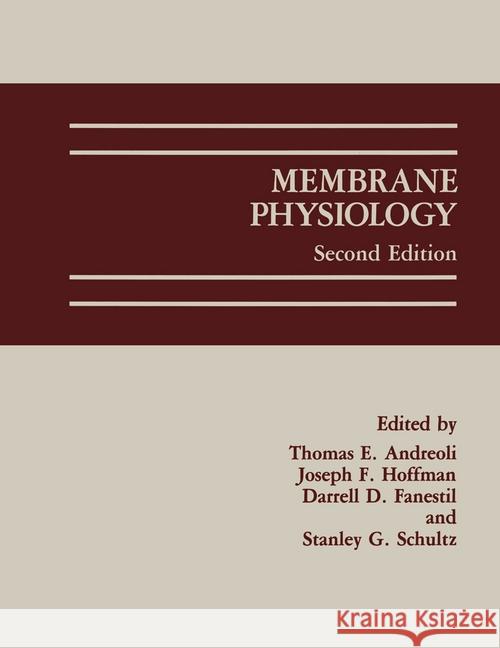
Thomas E. Andreoli; Darrell D. Fanestil; Joseph F. Hoffman
Membrane Physiology Thomas E. Andreoli Darrell D. Fanestil Joseph F. Hoffman 9780306426971 Plenum Medical Book Company - książkaWidoczna okładka, to zdjęcie poglądowe, a rzeczywista szata graficzna może różnić się od prezentowanej.

Membrane Physiology

ISBN-13: 9780306426971 / Angielski / Miękka / 1987 / 384 str.

Thomas E. Andreoli; Darrell D. Fanestil; Joseph F. Hoffman
cena 321,86
(netto: 306,53 VAT:  5%)

Najniższa cena z 30 dni: 308,26
Termin realizacji zamówienia:
ok. 22 dni roboczych
Dostawa w 2026 r.

Darmowa dostawa!

Membrane Physiology (Second Edition) is a soft-cover book containing portions of Physiology of Membrane Disorders (Second Edition). The parent volume contains six major sections. This text encompasses the first three sections: The Nature of Biological Membranes, Methods for Studying Membranes, and General Problems in Membrane Biology. We hope that this smaller volume will be helpful to individuals interested in general physiology and the methods for studying general physiology. THOMAS E. ANDREOLI JOSEPH F. HOFFMAN DARRELL D. FANESTIL STANLEY G. SCHULTZ vii Preface to the Second Edition The second edition of Physiology of Membrane Disorders represents an extensive revision and a considerable expansion of the first edition. Yet the purpose of the second edition is identical to that of its predecessor, namely, to provide a rational analysis of membrane transport processes in individual membranes, cells, tissues, and organs, which in tum serves as a frame of reference for rationalizing disorders in which derangements of membrane transport processes playa cardinal role in the clinical expression of disease. As in the first edition, this book is divided into a number of individual, but closely related, sections. Part V represents a new section where the problem of transport across epithelia is treated in some detail. Finally, Part VI, which analyzes clinical derangements, has been enlarged appreciably.


Kategorie:
Nauka, Medycyna
Kategorie BISAC:
Science > Cytologia
Medical > Nefrologia
Medical > Urologia i medycyna układu moczowo-płciowego
Wydawca:
Plenum Medical Book Company
Język:
Angielski
ISBN-13:
9780306426971
Rok wydania:
1987
Wydanie:
1987
Ilość stron:
384
Oprawa:
Miękka
Wolumenów:
01

I: The Nature of Biological Membranes.- 1: The Anatomy of Biological Interfaces.- 1. Introduction.- 2. Models of Membrane Structure.- 3. Membrane Junctions.- 4. Certain Specialized Membranes.- 5. Lipid-Protein Interactions in Model Membranes.- 6. Membrane Fluidity.- 7. Mechanisms of Protein-Lipid Interactions.- 8. Mueller-Rudin Bilayer Membranes.- 9. Freeze-Fracture-Etch Studies of Membranes.- 10. Summary.- References.- 2: Composition and Dynamics of Lipids in Biomembranes.- 1. Molecular Organization of Lipids in Biomembranes.- 2. Lipid Composition of Mammalian Cell Membranes.- 3. Molecular Structure of Membrane Lipids.- 4. Molecular Motions in Bilayers.- 5. Interactions between Lipids in Bilayers.- 6. Summary.- References.- 3: Membrane Proteins: Structure, Arrangement, and Disposition in the Membrane.- 1. Introduction.- 2. Protein Composition of Membranes.- 3. Types of Membrane Proteins.- 4. Extrinsic Proteins.- 5. Intrinsic Proteins.- 6. Types of Intrinsic Membrane Proteins.- 7. The Structure of the Intramembrane Portion.- 8. Disposition of Proteins in the Membrane.- 9. Summary.- References.- II: Methods for Studying Membranes.- 4: The Nature and Limitations of Electron Microscopic Methods in Biology.- 1. Introduction.- 2. The Conventional Transmission Electron Microscope.- 3. Specimen Preparation.- 4. Embedding.- 5. Sectioning.- 6. Positive Staining.- 7. Negative Staining.- 8. Low-Dose Electron Microscopy.- 9. The Freeze-Fracture-Etch (FFE) Technique.- 10. Summary.- References.- 5: Isolation and Characterization of Biological Membranes.- 1. Introduction.- 2. Methods for Dissociating and Separating Cells.- 3. Isolation of Plasma Membranes.- 4. Assessment of Purification.- 5. Expression of Data.- 6. Functional Properties of Plasma Membranes.- 7. Pathological Considerations.- 8. Summary.- References.- 6: Absorption and Optical Rotation Spectra of Biological Membranes: Distortions and Their Corrections.- 1. Introduction.- 2. Distortions and Corrections for Suspensions.- 3. Purple Membrane as a Sample Calculation.- 4. Summary.- References.- 7: Mathematical Models of Membrane Transport Processes.- 1. Introduction.- 2. Diffusion.- 3. Osmosis.- 4. Ionic Diffusion.- 5. Facilitated Diffusion.- 6. Single-File Diffusion.- 7. Summary.- References.- 8: Application of Tracers to the Study of Membrane Transport Processes.- 1. Introduction.- 2. Tracers and Problems in the Use of Tracers.- 3. Isotope Effects.- 4. Rate Processes.- 5. Compartmental Systems and Compartmental Analysis.- 6. Theoretical Foundations for the Use of Tracers to Measure Rates.- 7. Applications to the Study of Membrane Transports.- 8. Summary.- References.- 9: Principles of Electrical Methods for Studying Membrane Movements of Ions.- 1. Introduction.- 2. Steady-State Characteristics of Biological Membranes.- 3. Non-Steady-State Electrical Properties of Membranes.- 4. Fluctuation Analysis of Electrical Properties of Membranes.- 5. Single-Channel Studies.- 6. Summary.- 7. Appendix.- References.- 10: The Study of Transport and Enzymatic Processes in Reconstituted Biological Systems.- 1. Introduction.- 2. Energy-Linked Processes.- 3. Receptors and Channels.- 4. Passive Transport System.- 5. Summary.- References.- III: General Problems in Membrane Biology.- 11: Principles of Water and Nonelectrolyte Transport across Membranes.- 1. Introduction.- 2. Diffusion as a Permeation Mechanism.- 3. Activation Energy for Diffusion: Measurement and Significance.- 4. Convection.- 5. Osmosis.- 6. Water and Nonelectrolyte Membrane Permeation Mechanisms.- 7. Summary.- References.- 12: Anion Transport in Erythrocytes.- 1. Introduction.- 2. Modes of Anion Transport.- 3. Anion Exchange in Human Erythrocytes.- 4. Net Anion Transport in Red Blood Cells.- 5. Cation-Coupled Anion Transport.- 6. Anion Transport in Other Single Cells.- 7. Relationship of Red Cell Anion Transport to Other Transport Systems.- 8. Summary.- References.- 13: Active Transport of Na+ and K+ by Red Blood Cells.- 1. Introduction.- 2. Intracellular Solutes and Water.- 3. Donnan and “Double Donnan” Equilibrium.- 4. Membrane Potential.- 5. Active Transport.- 6. Properties of the Na+, K+ Pump.- 7. Transport Modes of the Na+,K+ Pump.- 8. Ion Selectivity of the Na+,K + Pump.- 9. Ouabain and the Na+,K+ Pump.- 10. Molecular Mechanism of the Na+,K+ Pump.- References.- 14: Weak Electrolyte Transport across Biological Membranes: General Principles.- 1. Introduction.- 2. Weak Electrolyte Diffusion.- 3. Complex Mechanisms.- 4. Summary.- References.- 15: Ion Permeation in Cell Membranes.- 1. Introduction.- 2. How Ion Permeation Is Studied.- 3. Deviations from Independence.- 4. Gramicidin.- 5. Acetylcholine Receptor Channel.- 6. Voltage-Gated Sodium Channel.- 7. Potassium Channels.- 8. Calcium Channels.- 9. Summary.- References.- 16: Processing and Sorting of Proteins Synthesized in the Endoplasmic Reticulum.- 1. Introduction.- 2. Cotranslational Processing of Proteins.- 3. Posttranslational Processing of Proteins.- 4. Regulation of Protein Sorting and Membrane Interactions.- Summary.- References.- 17: Ion-Coupled Transport of Organic Solutes across Biological Membranes.- 1. Introduction.- 2. Sodium-Coupled Sugar and Amino Acid Transport by Small Intestine and Renal Proximal Tubule.- 3. Proton-Coupled Galactoside Transport by E. coli.- 4. Toward a Mechanicokinetic Model of Ion-Coupled Nonelectroly te Transport.- 5. Conclusions.- References.- 18: Bioenergetics of Membrane Transport Processes.- 1. Introduction.- 2. The Control of Mitochondrial Respiration.- 3. Thermogenesis.- 4. Respiration and Active Plasma Membrane Transport in Intact Cells.- 5. Summary.- References.- 19: Regulation of Cellular Volume.- 1. Introduction.- 2. Historical Perspective.- 3. The Gibbs-Donnan Equilibrium.- 4. The “Double Donnan” Hypothesis and Cellular Volume Regulation.- 5. Estimates of Cellular Colloid Osmotic Pressure.- 6. The Specificity of Cellular Sodium Chloride in Cellular Volume Regulation.- 7. Consequences of Metabolic Inhibition.- 8. Plasma Membrane Permeability and Cellular Volume.- 9. Regulation of Cellular Volume in Media Containing Cardiac Glycosides.- 10. Cellular Volume Regulation by Means Other Than the Cardiac Glycoside Sensitive Na+, K+ -ATPase.- 11. The Regulation of Volume in Cells Exposed to Anisosmotic Media.- 12. Summary and Conclusions.- References.- 20: Cell-to-Cell Communication: Permeability, Regulation, Formation, and Functions of the Cell-Cell Membrane Channel in Cell Junctions.- 1. Introduction.- 2. The Cell-to-Cell Membrane Channel.- 3. Regulation of the Cell-to-Cell Channel.- 4. Channel Formation.- 5. Physiological Roles of the Cell-to-Cell Channels.- References.- 21: Genes and Membranes.- 1. Introduction.- 2. Genetic Methods.- 3. Criteria for Establishing That Differences in Membrane Properties are Genetically Determined.- 4. Information That Can Be Gained from Biochemical and Physiological Studies on Transport Mutants and from Cloning Studies.- 5. Information That Can Be Gained from Genetic Analysis.- 6. Summary.- References.- 22: The Interaction of Hormones with Biological Membranes.- 1. Introduction.- 2. Hormone Interaction with Receptor.- 3. Subunit Composition of Membrane Receptors.- 4. Transduction of Response to Interaction of Hormone and Receptor.- 5. Fate of Hormone-Receptor Complex.- 6. Down-Regulation of Surface Membrane Content of Receptors.- 7. Interactions between Receptors for Different Hormones.- 8. Summary.- References.- 23: Modification of Membrane Function by Drugs.- 1. Introduction.- 2. Drugs Affecting Transport Mechanisms of the Plasma Membrane.- 3. Drugs Affecting Excitation Phenomena.- 4. Drugs Affecting Coupling Mechanisms of Membranes.- 5. Summary.- References.


Udostępnij

Facebook - konto krainaksiazek.pl


Opinie o Krainaksiazek.pl na Opineo.pl

Partner Mybenefit

Krainaksiazek.pl w programie rzetelna firma Krainaksiaze.pl - płatności przez paypal

Czytaj nas na:

Facebook - krainaksiazek.pl
  • książki na zamówienie
  • granty
  • książka na prezent
  • kontakt
  • pomoc
  • opinie
  • regulamin
  • polityka prywatności

Zobacz:

  • Księgarnia czeska

  • Wydawnictwo Książkowe Klimaty

1997-2025 DolnySlask.com Agencja Internetowa

© 1997-2022 krainaksiazek.pl
     
KONTAKT | REGULAMIN | POLITYKA PRYWATNOŚCI | USTAWIENIA PRYWATNOŚCI
Zobacz: Księgarnia Czeska | Wydawnictwo Książkowe Klimaty | Mapa strony | Lista autorów
KrainaKsiazek.PL - Księgarnia Internetowa

Polityka prywatnosci - link
Krainaksiazek.pl - płatnośc Przelewy24
Przechowalnia Przechowalnia





