• Wyszukiwanie zaawansowane
  • Kategorie
  • Kategorie BISAC
  • Książki na zamówienie
  • Promocje
  • Granty
  • Książka na prezent
  • Opinie
  • Pomoc
  • Załóż konto
  • Zaloguj się

Handbook of the Behavioral Neurobiology of Serotonin: Volume 21 » książka


zaloguj się | załóż konto
Logo Krainaksiazek.pl

koszyk

konto

szukaj
topmenu
Księgarnia internetowa
Szukaj
Książki na zamówienie
Promocje
Granty
Książka na prezent
Moje konto
Pomoc
 
 
Wyszukiwanie zaawansowane
Pusty koszyk
Bezpłatna dostawa dla zamówień powyżej 20 złBezpłatna dostawa dla zamówień powyżej 20 zł

Kategorie główne

• Nauka
 [2949965]
• Literatura piękna
 [1857847]

  więcej...
• Turystyka
 [70818]
• Informatyka
 [151303]
• Komiksy
 [35733]
• Encyklopedie
 [23180]
• Dziecięca
 [617748]
• Hobby
 [139972]
• AudioBooki
 [1650]
• Literatura faktu
 [228361]
• Muzyka CD
 [398]
• Słowniki
 [2862]
• Inne
 [444732]
• Kalendarze
 [1620]
• Podręczniki
 [167233]
• Poradniki
 [482388]
• Religia
 [509867]
• Czasopisma
 [533]
• Sport
 [61361]
• Sztuka
 [243125]
• CD, DVD, Video
 [3451]
• Technologie
 [219309]
• Zdrowie
 [101347]
• Książkowe Klimaty
 [123]
• Zabawki
 [2362]
• Puzzle, gry
 [3791]
• Literatura w języku ukraińskim
 [253]
• Art. papiernicze i szkolne
 [7933]
Kategorie szczegółowe BISAC

Handbook of the Behavioral Neurobiology of Serotonin: Volume 21

ISBN-13: 9780123746344 / Angielski / Twarda / 2009 / 818 str.
Muller, Christian P.
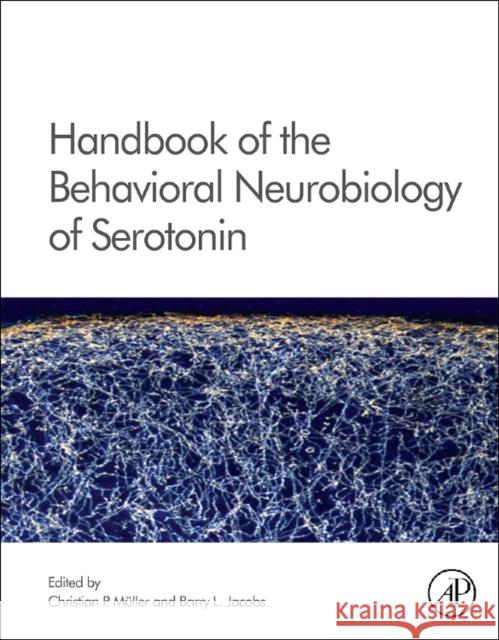
Handbook of the Behavioral Neurobiology of Serotonin: Volume 21 Muller, Christian P. 9780123746344 ELSEVIER SCIENCE & TECHNOLOGY - książkaWidoczna okładka, to zdjęcie poglądowe, a rzeczywista szata graficzna może różnić się od prezentowanej.

Handbook of the Behavioral Neurobiology of Serotonin: Volume 21

ISBN-13: 9780123746344 / Angielski / Twarda / 2009 / 818 str.

Muller, Christian P.
cena 741,43
(netto: 706,12 VAT:  5%)

Najniższa cena z 30 dni: 733,85
Termin realizacji zamówienia:
ok. 30 dni roboczych
Bez gwarancji dostawy przed świętami

Darmowa dostawa!

Serotonin (5-hydroxytryptamine, often cited as 5-HT) is one of the major excitatory neurotransmitter, and the serotonergic system is one of the best studied and understood transmitter systems. It is crucially involved in the organization of virtually all behaviours and in the regulation of emotion and mood. Alterations in the serotonergic system, induced by e.g. learning or pathological processes, underlie behavioural plasticity and changes in mood, which can finally results in abnormal behaviour and psychiatric conditions. Not surprisingly, the serotonergic system and its functional components appear to be targets for a multitude of pharmacological treatments - examples of very successful drugs targeting the serotoninergic system include Prozac and Zoloft.

The last decades of research have not only fundamentally expanded our view on serotonin but also revealed in much more detail an astonishing complexity of this system, which comprises a multitude of receptors and signalling pathways. A detailed view on its role in basal, but also complex, behaviours emerged, and, was presented in a number of single review articles. Although much is known now, the serotonergic system is still a fast growing field of research contributing to our present understanding of the brains function during normal and disturbed behaviour.

This handbook aims towards a detailed and comprehensive overview over the many facets of behavioural serotonin research. As such, it will provide the most up to date and thorough reading concerning the serotonergic systems control of behaviour and mood in animals and humans. The goal is to create a systematic overview and first hand reference that can be used by students and scholars alike in the fields of genetics, anatomy, pharmacology, physiology, behavioural neuroscience, pathology, and psychiatry. The chapters in this book will be written by leading scientists in this field. Most of them have already written excellent reviews in their field of expertise.

The book is divided in 4 sections. After an historical introduction, illustrating the growth of ideas about serotonin function in behaviour of the last forty years, section A will focus on the functional anatomy of the serotonergic system. Section B provides a review of the neurophysiology of the serotonergic system and its single components. In section C the involvement of serotonin in behavioural organization will be discussed in great detail, while section D deals with the role of serotonin in behavioural pathologies and psychiatric disorders.

  • The first handbook broadly discussing the behavioral neurobiology of the serotonorgic transmitter system
  • Co-edited by one of the pioneers and opinion leaders of the past decades, Barry Jacobs (Princeton), with an international list (10 countries) of highly regarded contributors providing over 50 chapters, and including the leaders in the field in number of articles and citations: K. P. Lesch, T. Sharp, A. Caspi, P. Blier, G.K. Aghajanian, E. C. Azmitia, and others
  • The only integrated and complete resource on the market containing the best information integrating international research, providing a global perspective to an international community
  • Of great value not only for researchers and experts, but also for students and clinicians as a background reference


Kategorie:
Nauka, Medycyna
Kategorie BISAC:
Medical > Farmakologia
Medical > Neurologia i neurofizjologia kliniczna
Medical > Neuroscience
Wydawca:
ELSEVIER SCIENCE & TECHNOLOGY
Seria wydawnicza:
Handbook of Behavioral Neuroscience
Język:
Angielski
ISBN-13:
9780123746344
Rok wydania:
2009
Numer serii:
000224554
Ilość stron:
818
Waga:
2.43 kg
Wymiary:
27.69 x 21.59 x 4.57
Oprawa:
Twarda
Wolumenów:
01
Dodatkowe informacje:
Bibliografia
Wydanie ilustrowane

"This book was overdue for a long time and I think that it has the chance to be a bestseller in this area."--Boris Quednow, Psychiatric Hospital, University Zurich, Switzerland

Section 1: Functional anatomy of the serotonergic system 1.1 Evolution of serotonin: sunlight to suicide by Efrain C. Azmitia; 1.2. Genetic organisation of the serotonergic system by Ursula M. D'Souza and Ian W. Craig; 1.3. The neuronatomy of the serotonergic system by Jean-Pierre Hornung; 1.4. Ultrastructure of the serotonin innervation in mammalian central nervous system by Laurent Descarries Mustapha Riad and Martin Parent; 1.5. Classification and signaling characteristics of 5-HT receptors by Joël Bockaert, Sylvie Claeysen, Aline Dumuis and Philippe Marin; 1.6. Distribution of 5-HT receptors in the central nervous system by Guadalupe Mengod, Roser Cortés, M. Teresa Vilaró and Daniel Hoyer; 1.7. Measuring serotonin activity in vivo in the brains of animals and humans by Charles A Marsden

Section 2: The neurophysiology of serotonin 2.1 Activity of brain serotonergic neurons in relation to physiology and behavior by Barry L. Jacobs and Casimir A. Fornal; 2.2 Electrophysiology of serotonin receptors by Gerard J. Marek; 2.3 Tryptophane hydroxylase and serotonin synthesis regulation by Hiroyuki Hasegawa and Kazuhiro Nakamura; 2.4 The degradation of serotonin: role of MAO by Marco Bortolato, Kevin Chen and Jean C Shih; 2.5 Cellular effects of serotonin in the CNS by Rodrigo Andrade and Sheryl G. Beck; 2.6 Serotonergic feedback control by Trevor Sharp; 2.7 Tryptophan depletion and serotonin release - a critical reappraisal by Matthijs G.P. Feenstra and Geoffrey van der Plasse; 2.8 Serotonin interaction with other transmitter systems by Albert Adell, Analía Bortolozzi, Llorenç Díaz-Mataix, Noemí Santana, Pau Celada, and Francesc Artigas; 2.9 Serotonergic regulation of rhythmical activity of the brain, concentrating on the hippocampus by Robert P. Vertes; 2.10 5-HT neurons and central CO2 chemoreception by Carolin I. Dohle and George B. Richerson

Section 3: Serotonin and behavioural control 3.1 Serotonin and development by Patricia M. Whitaker-Azmitia; 3.2 Serotonin and basal sensory: motor control by Robert J. Carey; 3.3 Role of the serotonergic system in appetite and ingestion control by Michelle D. Lee and Peter G. Clifton; 3.4 Serotonin and sexual behavior by Lynda Uphouse and Jutatip Guptarak; 3.5 Serotonin in mood and emotion by Julie G. Hensler; 3.6 Serotonin and the neurobiology of anxious states by Christopher A. Lowry and Matthew W. Hale; 3.7 Role of Serotonin in Brain Reward and Regulation of Alcohol Drinking Behavior by W. J. McBride; 3.8 Role of central serotonin in impulsivity and compulsivity: Comparative studies in experimental animals and humans by TW Robbins & MJ Crockett; 3.9 Experimental studies on the role(s) of serotonin in learning and memory functions by Jean-Christophe Cassel; 3.10 Social behavior and serotonin by Elif Aysimi Duman and Turhan Canli; 3.11 Serotonin in pain and pain control by Claudia Sommer

Section 4: Serotonin in disease conditions 4.1 The Impact of Stress on Serotonergic Neurotransmission by Astrid C.E. Linthorst and Johannes M.H.M. Reul; 4.2 Role for serotonin in depression by Gregory V. Carr and Irwin Lucki; 4.3 The role of serotonin in drug addiction by Christian P. Müller, Martin E. Pum, Gunter Schumann and Joseph P. Huston; 4.4 The serotonergic system in obsessive compulsive disorders by Addy van Dijk, Andre Klompmakers, and Damiaan Denys; 4.5 The role of serotonin in attention-deficit hyperactivity disorder (ADHD) by Robert D. Oades; 4.6 Serotonin and schizophrenia by Boris B. Quednow, Mark A. Geyer, and Adam L. Halberstadt; 4.7 Serotonin and serotonin receptors in hallucinogen action by Adam L. Halberstadt and David E. Nichols; 4.8 The role of serotonin in cortical development: implications for Autism Spectrum Disorder [ASD] by Christine F. Hohmann and Mary E. Blue;  4.9 Serotonin in panic and anxiety disorders by Francisco Silveira Guimarães, Hélio Zangrossi Jr., Cristina Marta Del Ben and Frederico Guilherme Graeff; 4.10 Serotonin and agression by Isabel M. Quadros, Aki Takahashi and Klaus A. Miczek; 4.11 Altered serotonin function in anorexia and bulimia nervosa by Vikas Duvvuri, Ursula F Bailer and Walter H Kaye; 4.12 Genetic, epigenetic, and environmental factors in serotonin associated disease conditions by Eva Friedel and Andreas Heinz; 4.13 The Behavioral Genetics of Serotonin: Relevance to Anxiety and Depression by Olivia F. O'Leary and John F. Cryan; 4.14 Functional pharmacogenetics of serotonin receptors in psychiatric drug action by Olga O. Yevtushenko, Gavin P. Reynolds

Dr. Müller is Professor of Addiction Medicine at the Friedrich-Alexander-University Erlangen-Nuremberg, Germany. He obtained his PhD in Psychology from the University of Düsseldorf. He did PostDocs at the University of Syracuse (USA), University of Düsseldorf, and University of Brasilia (Brazil) before becoming a Senior Lecturer at the Institute of Psychiatry, King's College London, UK. In 2010 he joined the Friedrich-Alexander-University of Erlangen-Nuremberg, Germany. He serves on several journal editorial boards and guest edited special issues of Behavioral Brain Research and Brain Research Bulletin. Dr. Müller has published more than 120 scientific papers and book chapters.


Udostępnij

Facebook - konto krainaksiazek.pl


Opinie o Krainaksiazek.pl na Opineo.pl

Partner Mybenefit

Krainaksiazek.pl w programie rzetelna firma Krainaksiaze.pl - płatności przez paypal

Czytaj nas na:

Facebook - krainaksiazek.pl
  • książki na zamówienie
  • granty
  • książka na prezent
  • kontakt
  • pomoc
  • opinie
  • regulamin
  • polityka prywatności

Zobacz:

  • Księgarnia czeska

  • Wydawnictwo Książkowe Klimaty

1997-2025 DolnySlask.com Agencja Internetowa

© 1997-2022 krainaksiazek.pl
     
KONTAKT | REGULAMIN | POLITYKA PRYWATNOŚCI | USTAWIENIA PRYWATNOŚCI
Zobacz: Księgarnia Czeska | Wydawnictwo Książkowe Klimaty | Mapa strony | Lista autorów
KrainaKsiazek.PL - Księgarnia Internetowa

Polityka prywatnosci - link
Krainaksiazek.pl - płatnośc Przelewy24
Przechowalnia Przechowalnia





