3D Interconnect Architectures for Heterogeneous Technologies » książka





3D Interconnect Architectures for Heterogeneous Technologies
ISBN-13: 9783030982317 / Angielski / Miękka / 2023
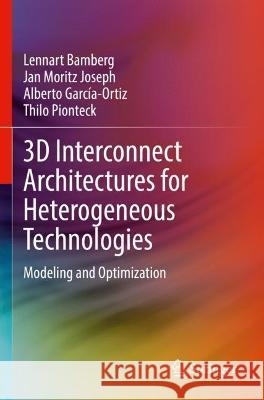
3D Interconnect Architectures for Heterogeneous Technologies
ISBN-13: 9783030982317 / Angielski / Miękka / 2023
(netto: 460,04 VAT: 5%)
Najniższa cena z 30 dni: 462,63
ok. 16-18 dni roboczych.
Darmowa dostawa!
This book describes the first comprehensive approach to the optimization of interconnect architectures in 3D systems on chips (SoCs), specially addressing the challenges and opportunities arising from heterogeneous integration. Readers learn about the physical implications of using heterogeneous 3D technologies for SoC integration, while also learning to maximize the 3D-technology gains, through a physical-effect-aware architecture design. The book provides a deep theoretical background covering all abstraction-levels needed to research and architect tomorrow’s 3D-integrated circuits, an extensive set of optimization methods (for power, performance, area, and yield), as well as an open-source optimization and simulation framework for fast exploration of novel designs.
Part I Introduction
1 Introduction to 3D Technologies
1.1 Motivation for Heterogenous 3D ICs
1.2 3D Technologies
1.3 TSV Capacitances—A Problem Resistant to Scaling
1.4 Conclusion
2 Interconnect Architectures for 3D Technologies
2.1 Interconnect Architectures2.2 Overview of Interconnect Architectures for 3D ICs
2.3 Three-dimensional Networks on chips
2.4 Conclusion
Part II 3D Technology Modeling
3 Power and Performance Formulas
3.1 High-Level Formula for the Power Consumption
3.2 High-Level Formula for the Propagation Delay3.3 Matrix Formulations
3.4 Evaluation
3.5 Conclusion
4 Capacitance Estimation
4.1 Existing Capacitance Models
4.2 Edge and MOS Effects on the TSV Capacitances
4.3 TSV Capacitance Model
4.4 Evaluation
4.5 Conclusion
Part III System Modeling
xiii
xiv Contents
5 Application and Simulation Models
5.1 Overview of the Modeling Approach
5.2 Application Traffic Model5.3 Simulation Model of 3D NoCs
5.4 Simulator Interfaces
5.5 Conclusion
6 Bit-level Statistics
6.1 Existing Approaches to Estimate the Bit-Level Statistics for
Single Data Streams
6.2 Data-Stream Multiplexing
6.3 Bit-Level Statistics with Data-Stream Multiplexing
6.4 Evaluation
6.5 Conclusion
7 Ratatoskr Framework
7.1 Ratatoskr for Practitioners
7.2 Implementation
7.3 Evaluation
7.4 Case Study: Link Power Estimation and Optimization7.5 Conclusion
Part IV 3D-Interconnect Optimization
8 Low-Power Technique for 3D Interconnects
8.1 Fundamental Idea
8.2 Power-Optimal TSV assignment
8.3 Systematic Net-to-TSV Assignments
8.4 Combination with Traditional Low-Power Codes8.5 Evaluation
8.6 Conclusion
9 Low-Power Technique for High-Performance 3D
Interconnects.
9.1 Edge-Effect-Aware Crosstalk Classification
9.2 Existing Approaches and Their Limitations
9.3 Proposed Technique9.4 Extension to a Low-Power 3D CAC
9.5 Evaluation
9.6 Conclusion
10 Low-Power Technique for High-Performance 3D
Interconnects (Misaligned)
10.1 Temporal-Misalignment Effect on the Crosstalk
10.2 Exploiting Misalignment to Improve the Performance
10.3 Effect on the TSV Power Consumption
Contents xv
10.4 Evaluation
10.5 Conclusion
11 Low-Power Technique for Yield-Enhanced 3D Interconnects
11.1 Existing TSV Yield-Enhancement Techniques
11.2 Preliminaries—Logical Impact of TSV Faults
11.3 Fundamental Idea
11.4 Formal Problem Description
11.5 TSV Redundancy Schemes
11.6 Evaluation
11.7 Case Study
11.8 Conclusion
Part V NoC Optimization for Heterogeneous 3D Integration
12 Heterogeneous Buffering for 3D NoCs251
12.1 Buffer Distributions and Depths
12.2 Routers with Optimized Buffer Distribution
12.3 Routers with Optimized Buffer Depths
12.4 Evaluation
12.5 Discussion
12.6 Conclusion
13 Heterogeneous Routing for 3D NoCs
13.1 Heterogeneity and Routing
13.2 Modeling Heterogeneous Technologies
13.3 Modeling Communication
13.4 Routing Limitations from Heterogeneity13.5 Heterogeneous Routing Algorithms
13.6 Heterogeneous Router Architectures
13.7 Low-Power Routing in Heterogeneous 3D ICs
13.8 Evaluation
13.9 Discussion
13.10Conclusion
14 Heterogeneous Virtualisation for 3D NoCs
14.1 Problem Description
14.2 Heterogeneous Microarchitectures Exploiting Traffic Imbalance
14.3 Evaluation
14.4 Conclusion15 Network Synthesis and SoC Floor Planning
15.1 Fundamental Idea
15.2 Modelling and Optimization
15.3 Mixed-Integer Linear Program
15.4 Heuristic Solution
xvi Contents
15.5 Evaluation
15.6 Conclusion
Part VI Finale
16 Conclusion
16.1 Putting it all together16.2 Impact on Future Work
A Appendix
B Pseudo Codes
C Method to Calculate the Depletion-Region Widths
D Modeling Logical OR Relations
Lennart Bamberg received the B.Sc., M.Sc., and Ph.D. (Dr.-Ing. ) degree with highest honours (“summa cum laude”) in electrical and computer engineering from the University of Bremen, Germany, in 2014, 2016, and 2020, respectively. In 2019, he was a Visiting Research Scholar at the Georgia Institute of Technology, Atlanta (USA). This stay was funded by a scholarship of the German Academic Exchange Service, DAAD, and the German Federal Ministry of Education and Research, BMBF. Afterwards, he was a Technical director at GrAI Matter Labs, where he was in charge of the processor architecture for edge AI. Since 2022, he is System Architect at NXP Semiconductors working on secure-element SoCs for mobile phones and wearables. In parallel, he serves as a guest lecturer at the University of Bremen in electrical engineering since 2020. Lennart Bamberg’s research interests include low-power and domain-specific computer architectures for embedded systems. He received best-paper awards at international conferences and serves as a reviewer and program-committee member for several international conferences and journals.
Jan Moritz Joseph got his B.Sc. in medical engineering in 2011 and his M.Sc. in computer science in 2014 from the Universität zu Lübeck, Germany. From 2008 to 2014 he was a scholarship holder of the German Merit Foundation (Deutsche Studienstiftung e.V.). Dr. Joseph received his Ph.D. from Otto-von-Guericke Universität Magdeburg, Germany, in 2019. The title of his thesis was "Networks-on-Chip for heterogeneous 3D Systems-on-Chip". His Ph.D. was awarded the highest honours “summa cum laude”. In 2020, he received the award for the best PhD thesis from the Faculty of Electrical Engineering and Information Technology at Otto-von-Guericke Universität Magdeburg, Germany. From 2019 to 2020 Dr. Joseph was a visiting researcher at Dr. Krishna’s Synergy Lab at Georgia Institute of Technology, Atlanta, GA. His stay was partially funded by a scholarship from the German Academic Exchange Service. He joined Institute for Communication Technologies and Embedded Systems, RWTH Aachen University, in June 2020 as a postdoctoral research fellow in the Chair for Software for Systems on Silicon. His research interest are architectures for NoCs, AI accelerators and neuromorphic computing as well as simulation and 3D integration.
Alberto García-Ortiz received the Diploma degree in telecommunication systems from the Polytechnic University of Valencia, Spain, in 1998, and the Ph.D. degree (summa cum laude) from the Department of Electrical Engineering and Information Technology, Institute of Microelectronic Systems, Darmstadt University of Technology, Germany, in 2003.,He worked at NewLogic, Austria, for two years. From 2003 to 2005, he worked as a Senior Hardware Design Engineer at the IBM Deutschland Research and Development, Böblingen. Then, he joined the start-up AnaFocus, Spain, where he was responsible for the design and integration of AnaFocus’ next generation Vision Systems-on-Chip. He is currently a Full Professor for the Chair of Integrated Digital Systems at the University of Bremen. His research interests include low-power design and estimation, communication-centric design, SoC integration, and variations-aware design. Dr. Garcia-Ortiz received the Outstanding Dissertation Award from the European Design and Automation Association, in 2004, and an Innovation Award from IBM, in 2005, for his contributions to leakage estimation; he holds two issued patents for that work. He serves as a reviewer of several conferences, journals, and European projects.
This book describes the first comprehensive approach to the optimization of interconnect architectures in 3D systems on chips (SoCs), specially addressing the challenges and opportunities arising from heterogeneous integration. Readers learn about the physical implications of using heterogeneous 3D technologies for SoC integration, while also learning to maximize the 3D-technology gains, through a physical-effect-aware architecture design. The book provides a deep theoretical background covering all abstraction-levels needed to research and architect tomorrow’s 3D-integrated circuits, an extensive set of optimization methods (for power, performance, area, and yield), as well as an open-source optimization and simulation framework for fast exploration of novel designs.
Provides several optimization techniques for all key 3D-interconnect metrics;
Presents the only open-source NoC simulator for heterogenous 3D SoCs.




Czytaj nas na:
1997-2026 DolnySlask.com Agencja Internetowa
KrainaKsiazek.PL - Księgarnia Internetowa


