• Wyszukiwanie zaawansowane
  • Kategorie
  • Kategorie BISAC
  • Książki na zamówienie
  • Promocje
  • Granty
  • Książka na prezent
  • Opinie
  • Pomoc
  • Załóż konto
  • Zaloguj się

3-D Computer Vision: Principles, Algorithms and Applications » książka


zaloguj się | załóż konto
Logo Krainaksiazek.pl

koszyk

konto

szukaj
topmenu
Księgarnia internetowa
Szukaj
Książki na zamówienie
Promocje
Granty
Książka na prezent
Moje konto
Pomoc
 
 
Wyszukiwanie zaawansowane
Pusty koszyk
Bezpłatna dostawa dla zamówień powyżej 40 złBezpłatna dostawa dla zamówień powyżej 40 zł

Kategorie główne

• Nauka
 [3147210]
• Literatura piękna
 [2059897]

  więcej...
• Turystyka
 [57377]
• Informatyka
 [177653]
• Komiksy
 [39871]
• Encyklopedie
 [25164]
• Dziecięca
 [764854]
• Hobby
 [103258]
• AudioBooki
 [1544]
• Literatura faktu
 [252777]
• Muzyka CD
 [354]
• Słowniki
 [4129]
• Inne
 [510621]
• Kalendarze
 [2095]
• Podręczniki
 [182552]
• Poradniki
 [580872]
• Religia
 [645908]
• Czasopisma
 [540]
• Sport
 [73803]
• Sztuka
 [272406]
• CD, DVD, Video
 [3411]
• Technologie
 [253912]
• Zdrowie
 [131070]
• Książkowe Klimaty
 [128]
• Zabawki
 [2664]
• Puzzle, gry
 [4721]
• Literatura w języku ukraińskim
 [274]
• Art. papiernicze i szkolne
 [8162]
Kategorie szczegółowe BISAC

3-D Computer Vision: Principles, Algorithms and Applications

ISBN-13: 9789811975790 / Angielski / Twarda / 2023 / 444 str.
Yu-Jin Zhang
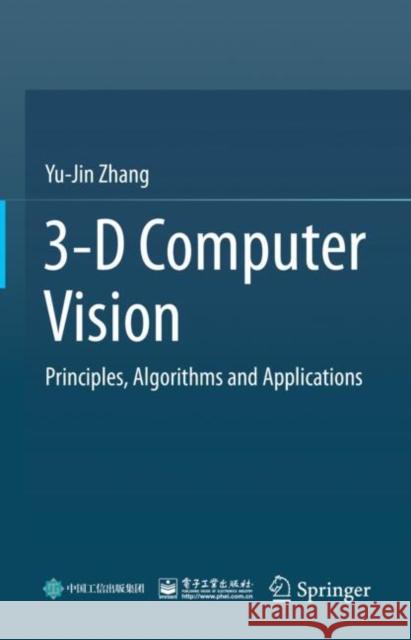
3-D Computer Vision: Principles, Algorithms and Applications Yu-Jin Zhang 9789811975790 Springer - książkaWidoczna okładka, to zdjęcie poglądowe, a rzeczywista szata graficzna może różnić się od prezentowanej.

3-D Computer Vision: Principles, Algorithms and Applications

ISBN-13: 9789811975790 / Angielski / Twarda / 2023 / 444 str.

Yu-Jin Zhang
cena 335,62
(netto: 319,64 VAT:  5%)

Najniższa cena z 30 dni: 308,41
Termin realizacji zamówienia:
ok. 16-18 dni roboczych.

Darmowa dostawa!
inne wydania

This textbook offers advanced content on computer vision (basic content can be found in its prerequisite textbook, “2D Computer Vision: Principles, Algorithms and Applications”), including the basic principles, typical methods and practical techniques. It is intended for graduate courses on related topics, e.g. Computer Vision, 3-D Computer Vision, Graphics, Artificial Intelligence, etc.The book is mainly based on my lecture notes for several undergraduate and graduate classes I have offered over the past several years, while a number of topics stem from my research publications co-authored with my students. This book takes into account the needs of learners with various professional backgrounds, as well as those of self-learners. Furthermore, it can be used as a reference guide for practitioners and professionals in related fields.To aid in comprehension, the book includes a wealth of self-test questions (with hints and answers). On the one hand, these questions help teachers to carry out online teaching and interact with students during lectures; on the other, self-learners can use them to assess whether they have grasped the key content.


This textbook offers advanced content on computer vision (basic content can be found in its prerequisite textbook, “2D Computer Vision: Principles, Algorithms and Applications”), including the basic principles, typical methods and practical techniques. It is intended for graduate courses on related topics, e.g. Computer Vision, 3-D Computer Vision, Graphics, Artificial Intelligence, etc. The book is mainly based on my lecture notes for several undergraduate and graduate classes I have offered over the past several years, while a number of topics stem from my research publications co-authored with my students. This book takes into account the needs of learners with various professional backgrounds, as well as those of self-learners. Furthermore, it can be used as a reference guide for practitioners and professionals in related fields. To aid in comprehension, the book includes a wealth of self-test questions (with hints and answers). On the one hand, these questions help teachers to carry out online teaching and interact with students during lectures; on the other, self-learners can use them to assess whether they have grasped the key content.

Widoczna okładka, to zdjęcie poglądowe, a rzeczywista szata graficzna może różnić się od prezentowanej. Nie gwarantujemy zgodności okładki z prezentowanym zdjęciem.
Kategorie:
Informatyka
Kategorie BISAC:
Computers > Software Development & Engineering - Computer Graphics
Computers > Artificial Intelligence - Computer Vision & Pattern Recognition
Technology & Engineering > Electronics - General
Wydawca:
Springer
Język:
Angielski
ISBN-13:
9789811975790
Rok wydania:
2023
Dostępne języki:
Ilość stron:
444
Oprawa:
Twarda

Chapter 1             Introduction

                1.1          Human Vision and Characteristics

                1.2          Computer Vision Theory and Model

                1.3          3D Vision System and Image Technology

                1.4          Book Overview

Chapter 2             Camera Calibration

                2.1    Linear Camera Model

                2.2          Non-Linear Camera Model

                2.3    Traditional Calibration Methods

                2.4    Self-Calibration Methods

Chapter 3             3D Image Acquisition

                3.1          High-Dimensional Image

                3.2          Depth Image

                3.3          Direct Depth Imaging

                3.4          Stereo Vision Imaging

Chapter 4             Video and Motion Information

                4.1    Video Basic

                4.2    Motion Classification and Representation

                4.3    Motion Information Detection

                4.4    Motion-Based Filtering

Chapter 5             Moving Object Detection and Tracking

                5.1    Differential Image

                5.2    Background Modeling

                5.3    Optical Flow Field and Motion

                5.4    Moving Object Tracking

Chapter 6             Binocular Stereo Vision

                6.1    Stereo Vision Process and Modules

                6.2    Region-Based Stereo Matching

                6.3    Feature-Based Stereo Matching

                6.4    Error Detection and Correction of Parallax Map

Chapter 7             Monocular Multiple Image Reconstruction

                7.1    Photometric Stereo

                7.2    Shape from Illumination

                7.3    Optical Flow Equation

                7.4    Shape from Motion

Chapter 8             Monocular Single Image Reconstruction

                8.1    Shape from Shading

                8.2    Solving Brightness Equation

                8.3    Shape from Texture

                8.4    Detection of Texture Vanishing Points

Chapter 9             3-D Scene Representation

                9.1    Local Features of the Surface

                9.2    3-D Surface Representation

                9.3    Construction and Representation of Iso-Surfaces

                9.4    Interpolate 3-D Surfaces from Parallel Contours

                9.5    3-D Entity Representation

Chapter 10          Scene Matching

                10.1   Matching Overview

                10.2   Object Matching

                10.3   Dynamic Pattern Matching

                10.4   Graph Theory and Graph Matching

                10.5   Line Drawing Signature and Matching

Chapter 11          Knowledge and Scene Interpretation

                11.1   Scene Knowledge

                11.2   Logic System

                11.3   Fuzzy Reasoning

                11.4   Scene Classification

Chapter 12          Spatial-Temporal Behavior Understanding

                12.1   Spatial-Temporal Technology

                12.2   Spatial-Temporal Interest Point Detection

                12.3   Spatial-Temporal Dynamic Trajectory Learning and Analysis

                12.4   Spatial-Temporal Action Classification and Recognition

Appendix A         Visual Perception

                A.1          Shape Perception

                A.2          Spatial Perception

                A.3          Motion Perception

Self-Test Questions Answers to Self-Test Questions Bibliography Subject Index


Yu-Jin ZHANG received his Ph.D. in Applied Science from the State University of Liège, Liège, Belgium, in 1989. From 1989 to 1993, he was a postdoctoral fellow and research fellow at the Delft University of Technology, Delft, the Netherlands. In 1993, he joined the Department of Electronic Engineering, Tsinghua University, Beijing, China, where he has been a Professor (since 1997) and tenured Professor (since 2014) of Image Engineering.

He is active in education on and research into image engineering (including image processing, image analysis, and image understanding) and has published more than 550 research papers and more than 50 books in this field.

He has served as program chair of the “Twenty-Fourth International Conference on Image Processing (ICIP’2017)” and several other international conferences. He is the Honorary Chairman of Supervisors (since 2020) of CSIG, a Fellow of SPIE (since 2011) and a Fellow of CSIG (since 2019).

This textbook offers advanced content on computer vision (basic content can be found in its prerequisite textbook, “2D Computer Vision: Principles, Algorithms and Applications”), including the basic principles, typical methods and practical techniques. It is intended for graduate courses on related topics, e.g. Computer Vision, 3-D Computer Vision, Graphics, Artificial Intelligence, etc. 

The book is mainly based on my lecture notes for several undergraduate and graduate classes I have offered over the past several years, while a number of topics stem from my research publications co-authored with my students. This book takes into account the needs of learners with various professional backgrounds, as well as those of self-learners. Furthermore, it can be used as a reference guide for practitioners and professionals in related fields. 

To aid in comprehension, the book includes a wealth of self-test questions (with hints and answers). On the one hand, these questions help teachers to carry out online teaching and interact with students during lectures; on the other, self-learners can use them to assess whether they have grasped the key content.




Udostępnij

Facebook - konto krainaksiazek.pl


Opinie o Krainaksiazek.pl na Opineo.pl

Partner Mybenefit

Krainaksiazek.pl w programie rzetelna firma Krainaksiaze.pl - płatności przez paypal

Czytaj nas na:

Facebook - krainaksiazek.pl
  • książki na zamówienie
  • granty
  • książka na prezent
  • kontakt
  • pomoc
  • opinie
  • regulamin
  • polityka prywatności

Zobacz:

  • Księgarnia czeska

  • Wydawnictwo Książkowe Klimaty

1997-2026 DolnySlask.com Agencja Internetowa

© 1997-2022 krainaksiazek.pl
     
KONTAKT | REGULAMIN | POLITYKA PRYWATNOŚCI | USTAWIENIA PRYWATNOŚCI
Zobacz: Księgarnia Czeska | Wydawnictwo Książkowe Klimaty | Mapa strony | Lista autorów
KrainaKsiazek.PL - Księgarnia Internetowa

Polityka prywatnosci - link
Krainaksiazek.pl - płatnośc Przelewy24
Przechowalnia Przechowalnia