• Wyszukiwanie zaawansowane
  • Kategorie
  • Kategorie BISAC
  • Książki na zamówienie
  • Promocje
  • Granty
  • Książka na prezent
  • Opinie
  • Pomoc
  • Załóż konto
  • Zaloguj się

100 Years of World Wars and Post-War Regional Collaboration: How to Create 'New World Order'? » książka


zaloguj się | załóż konto
Logo Krainaksiazek.pl

koszyk

konto

szukaj
topmenu
Księgarnia internetowa
Szukaj
Książki na zamówienie
Promocje
Granty
Książka na prezent
Moje konto
Pomoc
 
 
Wyszukiwanie zaawansowane
Pusty koszyk
Bezpłatna dostawa dla zamówień powyżej 20 złBezpłatna dostawa dla zamówień powyżej 20 zł

Kategorie główne

• Nauka
 [2952079]
• Literatura piękna
 [1850969]

  więcej...
• Turystyka
 [71058]
• Informatyka
 [151066]
• Komiksy
 [35579]
• Encyklopedie
 [23181]
• Dziecięca
 [620496]
• Hobby
 [139036]
• AudioBooki
 [1646]
• Literatura faktu
 [228729]
• Muzyka CD
 [379]
• Słowniki
 [2932]
• Inne
 [445708]
• Kalendarze
 [1409]
• Podręczniki
 [164793]
• Poradniki
 [480107]
• Religia
 [510956]
• Czasopisma
 [511]
• Sport
 [61267]
• Sztuka
 [243299]
• CD, DVD, Video
 [3411]
• Technologie
 [219640]
• Zdrowie
 [100984]
• Książkowe Klimaty
 [124]
• Zabawki
 [2281]
• Puzzle, gry
 [3363]
• Literatura w języku ukraińskim
 [258]
• Art. papiernicze i szkolne
 [8020]
Kategorie szczegółowe BISAC

100 Years of World Wars and Post-War Regional Collaboration: How to Create 'New World Order'?

ISBN-13: 9789811699696 / Angielski / Twarda / 2023 / 395 str.
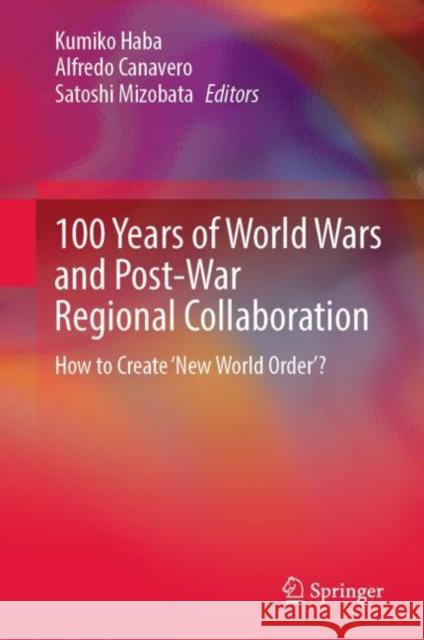
Kumiko Haba; Alfredo Canavero; Satoshi Mizobata
100 Years of World Wars and Post-War Regional Collaboration: How to Create 'New World Order'? Kumiko Haba Alfredo Canavero Satoshi Mizobata 9789811699696 Springer - książkaWidoczna okładka, to zdjęcie poglądowe, a rzeczywista szata graficzna może różnić się od prezentowanej.

100 Years of World Wars and Post-War Regional Collaboration: How to Create 'New World Order'?

ISBN-13: 9789811699696 / Angielski / Twarda / 2023 / 395 str.

Kumiko Haba; Alfredo Canavero; Satoshi Mizobata
cena 885,61
(netto: 843,44 VAT:  5%)

Najniższa cena z 30 dni: 771,08
Termin realizacji zamówienia:
ok. 22 dni roboczych.

Darmowa dostawa!
inne wydania

This book is about the 100 years of World Wars and Regional Collaboration in the twentieth and twenty-first centuries, investigating and considering how to foster Good Governance and New World Order. The world is currently at the historical turning point. The twentieth century witnessed two World Wars (WWI and WWII), followed by the Cold War that dominated geopolitics. Amidst the post-war devastation, the European Community, soon succeeded by the European Union, came into being. Peaceful governance was nurtured by building economic collaboration and institutions and by establishing liberalism, democracy and the rule of law. In Asia, the Association of Southeast Asian Nations (ASEAN) also pursued regional governance after WWII, but in East Asia, the American Divide and Rule policy is continuing until now by the influence of China, North Korea and Russia. In the contemporary world in the twenty-first century, a new nationalism, Populism and Authoritarianism are spreading. At the same time, a wave of rapid economic growth is occurring in developing countries, especially in China and India. Destabilization is spreading in East Asia, Southeast Asia, and South Asia concurrently with the search for “Democratization”.Through the two World Wars and the Cold War which originated in 100 years of the twentieth century, what types of regional institutions and governance have been developed to avoid endless wars and conflicts? In this book, it is examined, what kind of order is necessary to stabilize the regions from conflicts and wars in both Europe and Asia. The themes of the Tokyo Conferences and the Kyoto Conference by SCJ (Science Council of Japan) in December 2020, were investigated and clarified, how the countries that were caught up in global wars have considered regional coexistence in each period, and how to establish peace, stability, and prosperity by means of new institutionalizations, norms and the rule of law. The aim of the authors is to examine and discuss How to create New World Order, Regional Collaborations and Good Governance in the historical power transition period. This book can inspire many scholars and young researchers to join in discussing how to create New World Order in the twenty-first century, from the midst of the unstable situations of the global geopolitics.


This book is about the 100 years of World Wars and Regional Collaboration in the twentieth and twenty-first centuries, investigating and considering how to foster Good Governance and New World Order. The world is currently at the historical turning point. The twentieth century witnessed two World Wars (WWI and WWII), followed by the Cold War that dominated geopolitics. Amidst the post-war devastation, the European Community, soon succeeded by the European Union, came into being. Peaceful governance was nurtured by building economic collaboration and institutions and by establishing liberalism, democracy and the rule of law. In Asia, the Association of Southeast Asian Nations (ASEAN) also pursued regional governance after WWII, but in East Asia, the American Divide and Rule policy is continuing until now by the influence of China, North Korea and Russia. In the contemporary world in the twenty-first century, a new nationalism, Populism and Authoritarianism are spreading. At the same time, a wave of rapid economic growth is occurring in developing countries, especially in China and India. Destabilization is spreading in East Asia, Southeast Asia, and South Asia concurrently with the search for “Democratization”.


 Through the two World Wars and the Cold War which originated in 100 years of the twentieth century, what types of regional institutions and governance have been developed to avoid endless wars and conflicts? In this book, it is examined, what kind of order is necessary to stabilize the regions from conflicts and wars in both Europe and Asia. The themes of the Tokyo Conferences and the Kyoto Conference by SCJ (Science Council of Japan) in December 2020, were investigated and clarified, how the countries that were caught up in global wars have considered regional coexistence in each period, and how to establish peace, stability, and prosperity by means of new institutionalizations, norms and the rule of law. The aim of the authors is to examine and discuss How to create New World Order, Regional Collaborations and Good Governance in the historical power transition period. This book can inspire many scholars and young researchers to join in discussing how to create New World Order in the twenty-first century, from the midst of the unstable situations of the global geopolitics.

Kategorie:
Nauka, Polityka
Kategorie BISAC:
Political Science > World - European
Political Science > History & Theory - General
Religion > Religion, Politics & State
Wydawca:
Springer
Język:
Angielski
ISBN-13:
9789811699696
Rok wydania:
2023
Dostępne języki:
Ilość stron:
395
Oprawa:
Twarda
Dodatkowe informacje:
Wydanie ilustrowane

Preface
Juichi YAMAGIWA 1
Takaaki KAJITA 4
Prospectus
Kumiko HABA 6
Keynote Speech
1. The United Nations’ Contributions to Order: Treaties, Development, Human Rights, and Humanitarian Aid
Rector David MALONE 8
2. America’s Role in the New Global Order
Glen S. FUKUSHIMA 12
3. Afterimage of the British Empire? A Background of Brexit
Yoichi KIBATA 17
4. Post-Trump Challenges for US and Japan
Wataru SAWAMURA 24
5. Power Transition and 100 Years of World Wars ---Declining Great Powers and Reconstructing the New World Order---
Kumiko HABA 29
Chapter I: After World War I and the Inter-war Period 44
1-1 Disarmament and Equilibrium Between the Two World Wars (1919-1939)
Valdo FERRETTI 45
1-2 The Security of South-East Europe in the First Inter-war Decade.
"Greater Romania" between conflicting neighbourhoods and regional alliances
Claudiu-Lucian TOPOR 51
1-3 The Inevitable Revolution
Miguel Ángel VECINO 63
1-4 Eiichi Shibusawa’s Support for International Society through the League of Nations Association of Japan
Akiko IIMORI 69
Chapter II: Post-colonization in Europe and Asia 75
2-1 European Integration and Decolonization. From the Beginning to the Yaoundé, I Convention
Alfredo CANAVERO 76
2-2 Political Europe: The Cold War and the Great Decolonisation. From the Yaoundé Convention to the Lomé Conventions
Giulia LAMI 86
2-3 France, Decolonisation, and the Global South: France’s Struggle for a New World Order
Tomoya KURODA 101
2-4 North Korea and Wars in Africa and Asia
Satoru MIYAMOTO 108
Chapter III: After 100 Years of Wars: How to Make New World Order – Politics 114
3-1 The United States’ Differing Strategies of "New World Order" between Europe and Asia in the Post-War Period
Kumiko HABA 115
3-2 ‘I’m a Nationalist’: American Nationalism and Grand Strategy in the Age of Trump
J. Patrick BOYD 127
3-3 Do SAARC and BIMSTEC Lead the World? --- Regional Collaboration in South Asia
Pardeep Singh CHAUHAN 135
3-4 Transition of Economic and Political Leadership in East Asia since the Second World War
Sang-Chul PARK 141
3-5 Chinese Economic Growth and Prospects of a New International Monetary Regime
Chris G. POPE 155
Chapter IV: After 100 Years of Wars: How to Make New World Order – Economics 167
4-1 Fundamental EU Reform: Impact of the COVID Crisis
Steven ROSEFIELDE and Bruno DALLAGO 168
4-2 Connecting the EU and China along the Belt and Road Initiative
Bruno DALLAGO 182


Kumiko HABA is a Professor Emeritus at Aoyama Gakuin University,  President of the EUSA Asia Pacific (2017), Vice President of International Studies Association (2016-17), Vice President of ISA Asia Pacific (2018-21) and now President of ISA Asia Pacific (2021-24).  She is the Director of Institute for Global International Relations, Jean Monnet Chair of the European Union, Member of Science Council of Japan(2011-17), and Associate Member of SCJ(2017-23).  She was a Visiting Scholar at Harvard University (2011-12), European University Institute (2007), Sorbonne University (2004), University of London (1996-97) , and Hungarian Academy of Science (1995-96, 2002). Her specialty is International Relations, comparative studies between EU and Asian region, immigrant issues, and making peace and prosperity in conflict regions. She wrote 71 books (including editor and co-writer), 14 English books (including proceeding books), and 210 articles. Contemporary main works/books include the following:・Brexit and After, Perspectives on European Crises and reconstruction from Asia and Europe, (Editors) Springer, 2021, Encyclopedia of Central and East European Culture, (Representative Editor)Maruzen, 2021, Immigrants, Refugees and Minorities; Origin of European Populism, (Ed.), Sairysha, 2021,  European Division and Integration, European Nationalism and Borders, Inclusion or Exclusion, Chuo Koron Shinsha, Tokyo, 2016,・(Ed.), International Society in Great Transition era, Low and Culture Publishers, Tokyo, 2019.・ (Editors), The Unwinding of the Globalist DreamーEU, Russia and China, World Science, London, 2017. Asian Regional Cooperation in the Global Era, Iwanami Publishers, 2012 (Translated into Chinese).   Asian Regional Integration, To avoid Wars, Akashi Publishers, 2017.


Alfredo CANAVERO was born in Milan in 1948 and took a degree in Political Sciences at Milan Catholic University of Sacred Heart in 1970. He was Assistant professor of History of International Relations (1974-1980). Afterwards he has been teaching Contemporary History since 1977 at Milan State University, as Associate professor (1980) and then as full professor (2001). He is interested in Contemporary Italian History, History of Church and of Catholic movement, History of European Integration and History of Italian Foreign Policy. He was a member of the Scientific Committee of Historical Dictionary of Italian Catholic Movement (Marietti) and coordinator, with Jean-Dominique Durand (University of Lyon III), of an international research program on the role of Churches in political, social and economic life of Europe ("The Europe of Religious Spaces), in the frame of a larger group ("Spaces and Times of Europe") directed by Robert Frank (University of Paris I, Sorbonne). He was also Director of the Centre for the Studies of Foreign Policy and Public Opinion (Milan State University) and is General Secretary of the Commission of History of International Relations, affiliated to the World Congress of Historical Sciences. He gave papers during World Congresses of Historical Sciences from 1995 to 2015.


Satoshi Mizobata is Professor Emeritus and at the Kyoto Institute of Economic Research, Kyoto University, Japan. He is Council member of Science Council of Japan. He was awarded his degree of doctor in Economics at Kyoto University in 1997. He has investigated planned economies and transition economies based on the firm structure and corporate governance. He is chief editor of ISI-cited Journal of Comparative Economic Studies and contributes to editing of some other international journals. He is a member of the executive board of the European Association for Comparative Economic Studies. His recent publication: State-led innovation and uneven adaptation in Russia, in Steven Rosefielde ed., Putin’s Russia: Economy, Defense and Foreign Policy, World Scientific, 2020.

This book is about the 100 years of World Wars and Regional Collaboration in the twentieth and twenty-first centuries, investigating and considering how to foster Good Governance and New World Order. The world is currently at the historical turning point. The twentieth century witnessed two World Wars (WWI and WWII), followed by the Cold War that dominated geopolitics. Amidst the post-war devastation, the European Community, soon succeeded by the European Union, came into being. Peaceful governance was nurtured by building economic collaboration and institutions and by establishing liberalism, democracy and the rule of law. In Asia, the Association of Southeast Asian Nations (ASEAN) also pursued regional governance after WWII, but in East Asia, the American Divide and Rule policy is continuing until now by the influence of China, North Korea and Russia. In the contemporary world in the twenty-first century, a new nationalism, Populism and Authoritarianism are spreading. At the same time, a wave of rapid economic growth is occurring in developing countries, especially in China and India. Destabilization is spreading in East Asia, Southeast Asia, and South Asia concurrently with the search for “Democratization”.


 Through the two World Wars and the Cold War which originated in 100 years of the twentieth century, what types of regional institutions and governance have been developed to avoid endless wars and conflicts? In this book, it is examined, what kind of order is necessary to stabilize the regions from conflicts and wars in both Europe and Asia. The themes of the Tokyo Conferences and the Kyoto Conference by SCJ (Science Council of Japan) in December 2020, were investigated and clarified, how the countries that were caught up in global wars have considered regional coexistence in each period, and how to establish peace, stability, and prosperity by means of new institutionalizations, norms and the rule of law. The aim of the authors is to examine and discuss How to create New World Order, Regional Collaborations and Good Governance in the historical power transition period. This book can inspire many scholars and young researchers to join in discussing how to create New World Order in the twenty-first century, from the midst of the unstable situations of the global geopolitics.




Udostępnij

Facebook - konto krainaksiazek.pl


Opinie o Krainaksiazek.pl na Opineo.pl

Partner Mybenefit

Krainaksiazek.pl w programie rzetelna firma Krainaksiaze.pl - płatności przez paypal

Czytaj nas na:

Facebook - krainaksiazek.pl
  • książki na zamówienie
  • granty
  • książka na prezent
  • kontakt
  • pomoc
  • opinie
  • regulamin
  • polityka prywatności

Zobacz:

  • Księgarnia czeska

  • Wydawnictwo Książkowe Klimaty

1997-2026 DolnySlask.com Agencja Internetowa

© 1997-2022 krainaksiazek.pl
     
KONTAKT | REGULAMIN | POLITYKA PRYWATNOŚCI | USTAWIENIA PRYWATNOŚCI
Zobacz: Księgarnia Czeska | Wydawnictwo Książkowe Klimaty | Mapa strony | Lista autorów
KrainaKsiazek.PL - Księgarnia Internetowa

Polityka prywatnosci - link
Krainaksiazek.pl - płatnośc Przelewy24
Przechowalnia Przechowalnia




