Thomas Reid's Inquiry has long been recognized as a classic philosophical text. Since its first publication in 1764, there have followed no less than forty editions. The proliferation of secondary literature further indicates that Reid's work is flourishing as never before. Yet Reid scholars have been acutely aware of proceeding without the full textual evidence. There exist thousands of unpublished manuscript pages in Reid's hand, many of which relate directly to the composition of Inquiry. Furthermore, no account has been taken of the successive alterations made to the...
Thomas Reid's Inquiry has long been recognized as a classic philosophical text. Since its first publication in 1764, there have followed n...
Thomas Reid (1710-1796) is now recognized as one of the towering figures of the Enlightenment. Best known for his published writings on epistemology and moral theory, he was also an accomplished mathematician and natural philosopher, as an earlier volume of his manuscripts edited by Paul Wood for the Edinburgh Reid Edition, Thomas Reid on the Animate Creation, has shown.
The Correspondence of Thomas Reid collects all of the known letters to and from Reid in a fully annotated form. Letters already published by Sir William Hamilton and others have been...
Thomas Reid (1710-1796) is now recognized as one of the towering figures of the Enlightenment. Best known for his published writings on epistemolog...
Thomas Reid saw the three subjects of logic, rhetoric, and the fine arts as closely cohering aspects of one endeavor that he called the culture of the mind. This was a topic on which Reid lectured for many years in Glasgow, and this volume presents as near a reconstruction of these lectures as is now possible.
Though virtually unknown today, this material in fact relates closely to Reid's published works and in particular to the late Essays on the Intellectual Powers of Man and Essays on the Active Powers of Man. When composing these works, Reid drew primarily on...
Thomas Reid saw the three subjects of logic, rhetoric, and the fine arts as closely cohering aspects of one endeavor that he called the culture of ...
Thomas Reid's Inquiry has long been recognized as a classic text in the philosophy of mind. Reid scholars however, have been aware of the lack of full textual evidence when analyzing the composition of the piece. this work therefore presents a complete, critically edited text of the Inquiry, based on the fourth life-time edition (published in 1785), which contains notes including biographical details and allusions, translations, references to secondary literature and selected passages from Reid's MSS.
Thomas Reid's Inquiry has long been recognized as a classic text in the philosophy of mind. Reid scholars however, have been aware of the lack of full...
Thomas Reid (1710-96) is now recognized as one of the towering figures of the Enlightenment. Best known for his published writings on epistemology and moral theory, he was also an accomplished mathematician and natural philosopher, as an earlier volume of his manuscripts edited by Paul Wood for Edinburgh University Press, Thomas Reid on the Animate Creation, has shown.
Thomas Reid (1710-96) is now recognized as one of the towering figures of the Enlightenment. Best known for his published writings on epistemology and...
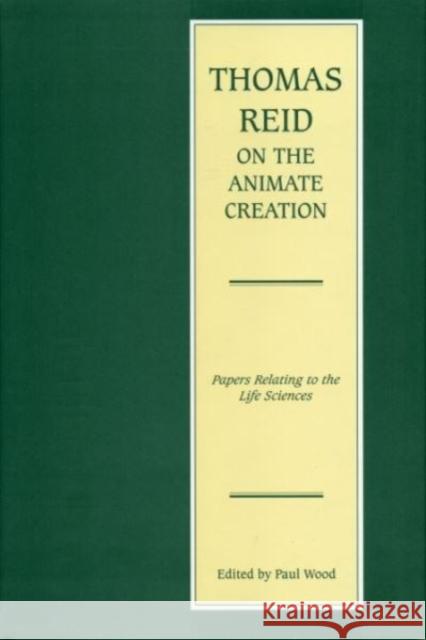
Best known as a moralist and one of the founders of the Scottish Common Sense school of philosophy, Thomas Reid (1710-96) was also an influential scientific thinker. Here his work on the life sciences is studied in detail, bringing together unpublished transcripts of his most important papers on natural history, physiology, and materialist metaphysics.
Part I provides the first published account of Reid's reflections on the highly controversial theories surrounding muscular motion and the reproduction of plants and animals and relates them to the broader Enlightenment debates on...
Best known as a moralist and one of the founders of the Scottish Common Sense school of philosophy, Thomas Reid (1710-96) was also an influential s...
This scarce antiquarian book is a facsimile reprint of the original. Due to its age, it may contain imperfections such as marks, notations, marginalia and flawed pages. Because we believe this work is culturally important, we have made it available as part of our commitment for protecting, preserving, and promoting the world's literature in affordable, high quality, modern editions that are true to the original work.
This scarce antiquarian book is a facsimile reprint of the original. Due to its age, it may contain imperfections such as marks, notations, marginalia...
Shows how principles of Common Sense philosophy are involved in volition, action and the ability to judge morally, giving an original twist to a libertarian and realist tradition that was prominently represented in eighteenth-century British thought .
Shows how principles of Common Sense philosophy are involved in volition, action and the ability to judge morally, giving an original twist to a liber...
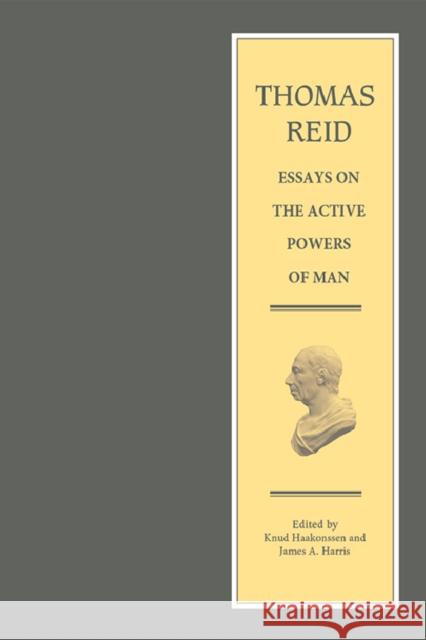
Essays on the Active Powers of Man (1788) was Thomas Reid's last major work. It was conceived as part of one large work, intended as a final synoptic statement of his overall philosophy. The first and larger part was published three years earlier as Essays on the Intellectual Powers of Man (edited as volume 3 of the Edinburgh Edition of Thomas Reid). These two works are united by Reid's basic philosophy of Common Sense, which sets out native principles by which the mind operates in both its intellectual and active aspects. The Active Powers shows how...
Essays on the Active Powers of Man (1788) was Thomas Reid's last major work. It was conceived as part of one large work, intended as a fin...