For more than 150 years, English men and women had planted themselves along the Atlantic Coast of the New World as colonists, intent on creating new lives of possibility and opportunity. But by the 1760s, countless thousands of people who had been loyal to king and country began to question that same loyalty. As British authorities began to hamper the lives the colonists had created, many in America followed a new course of action. As policies brought protest and taxes represented tyranny, those colonists ceased to consider themselves English subjects and came to view themselves as Americans...
For more than 150 years, English men and women had planted themselves along the Atlantic Coast of the New World as colonists, intent on creating new l...
For thousands of years, the first residents of the Western Hemisphere had established unique worlds for themselves. From their earliest Ice Age ancestors' arrival across the Bering Land Bridge in 10,000 BCE until 500 years ago, American Indians flourished on the North, Central, and South American continents. Highly sophisticated tribal or national identities, based on social, political, and religious customs, were developed. Establishing the cornerstones of civilized native life, including hunting, fishing, gathering, and farming, these peoples fashioned weapons and tools out of simple...
For thousands of years, the first residents of the Western Hemisphere had established unique worlds for themselves. From their earliest Ice Age ancest...
From the final decades of the 1500s through the mid-1700s, the North American continent witnessed a whirlwind of competition and colonization as European powers vied to establish their place in the northern reaches of the New World. Each powerOCowhether England, France, Holland, Spain, or othersOCorelied on strong-willed individuals who were driven by motives as different as night and dayOCofrom religious freedom to gold and glory. These adventurous people served as conquerors and colonists, explorers and evangelists, promoters and profiteers, farmers and freemen, Puritans and planters,...
From the final decades of the 1500s through the mid-1700s, the North American continent witnessed a whirlwind of competition and colonization as Europ...
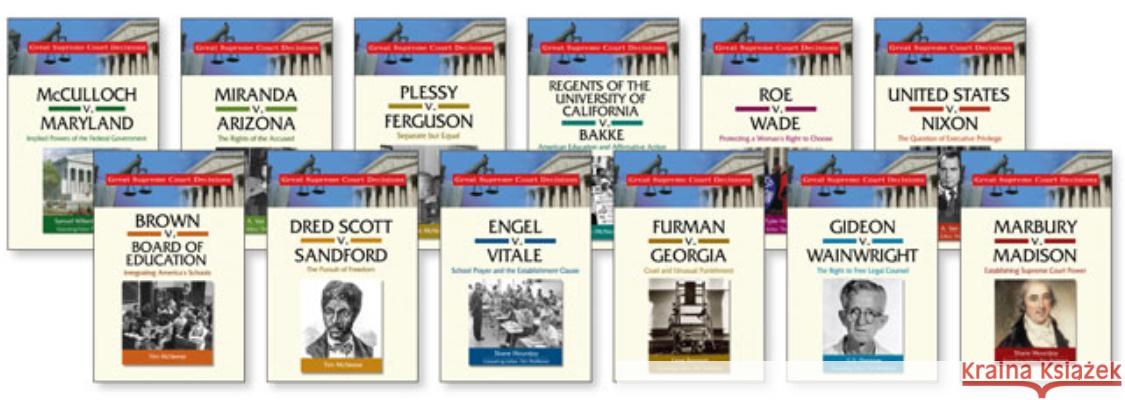
"The Great Supreme Court Decisions" series spotlights important Supreme Court cases that have had a resounding impact on life in the United States. Presented clearly and objectively, this series follows key cases from their inception through the highest court and explains the legacy of each decision. Students will learn about the American legal process, important judicial figures, and how each case changed the nation. The text is enhanced by full-color photographs, informative sidebars, a helpful chronology/timeline, source notes, suggestions for further reading, glossary, a bibliography, and...
"The Great Supreme Court Decisions" series spotlights important Supreme Court cases that have had a resounding impact on life in the United States. Pr...
This biography of Robert E. Lee examines his life and career before, during and after the American Civil War. Asked to take command of the Union Army by President Lincoln, family loyalty led him to refuse and to fight for his native Virginia. After the war, he supported reconciliation and he became popular in both the North and South.
This biography of Robert E. Lee examines his life and career before, during and after the American Civil War. Asked to take command of the Union Army ...