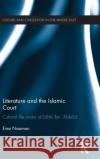
Courts were the most important frameworks for the production, performance, and evaluation of literature in medieval Islamic civilization. Patrons vying for prestige attracted to their courts literary people who sought their financial support. The most successful courts assembled outstanding literary people from across the region.
The court of the vizier and literary person al-Sahib Ibn Abbad (326-385/938-995) in western Iran is one of the most remarkable examples of a medieval Islamic court, with a sophisticated literary activity in Arabic (and, to a lesser extent, in...
Courts were the most important frameworks for the production, performance, and evaluation of literature in medieval Islamic civilization. Patrons v...
New Horizons in Qur'anic Linguistics provides a panoramic insight into the Qur'anic landscape fenced by innate syntactic, semantic and stylistic landmarks where context and meaning have closed ranks to impact morphological form in order to achieve variegated illocutionary forces. It provides a comprehensive account of the recurrent syntactic, stylistic, morphological, lexical, cultural, and phonological voids that are an iceberg looming in the horizon of Qur'anic genre. It is an invaluable resource for contrastive linguistics, translation studies, and corpus linguistics. Among the...
New Horizons in Qur'anic Linguistics provides a panoramic insight into the Qur'anic landscape fenced by innate syntactic, semantic and sty...
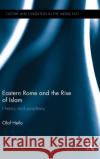
The emergence of Islam in the seventh century AD still polarises scholars who seek to separate religious truth from the historical reality with which it is associated. However, history and prophecy are not solely defined by positive evidence or apocalyptic truth, but by human subjects, who consider them to convey distinct messages and in turn make these messages meaningful to others. These messages are mutually interdependent, and analysed together provide new insights into history.
It is by way of this concept that Olof Heilo presents the decline of the Eastern Roman Empire as a...
The emergence of Islam in the seventh century AD still polarises scholars who seek to separate religious truth from the historical reality with whi...
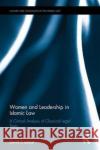
Islamic law has traditionally prohibited women from being prayer leaders and heads of state. A small number of Muslims today are beginning to challenge this stance, but they face considerable opposition from the broader Muslim community.
Women and Leadership in Islamic Law examines the assumption within much existing feminist scholarship that the patriarchal nature of pre-Islamic and early Muslim Near Eastern Society is the primary reason for the development of Islamic legal rulings prohibiting women from leadership positions. It claims that the evolution of Islamic law was...
Islamic law has traditionally prohibited women from being prayer leaders and heads of state. A small number of Muslims today are beginning to chall...
The subject of "human free-will" versus "divine predestination" is one of the most contentious topics in classical Islamic thought. By focusing on a theme of central importance to any philosophy of religion, and to Islam in particular, this book offers a critical study of the intellectual contributions offered to this discourse by three key medieval Islamic thinkers: Avicenna, al-Gh z l and Ibn Arab .
Through investigation of primary sources, Free Will and Predestination in Islamic Thought establishes the historical, political and intellectual circumstances...
The subject of "human free-will" versus "divine predestination" is one of the most contentious topics in classical Islamic thought. By focu...
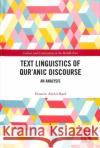
Text Linguistics of Qur'anic Discourse: A Text Analysis offers one of the first comprehensive investigations in the new academic discipline of Qu'ranic text linguistics, applying Western linguistics theory to Qur'anic discourse. Its informed and detailed analysis of Qur'anic discourse covers key elements including
(i) the texture of the macro Qur'anic text,
(ii) the cohesion and coherence systems of the Qur'anic text,
(iii) the major notions of the macro Qur'anic text such as intertextuality, semantic relatedness, and thematic sequentiality,
(iv) the macro...
Text Linguistics of Qur'anic Discourse: A Text Analysis offers one of the first comprehensive investigations in the new academic discipline of Qu'r...