• Wyszukiwanie zaawansowane
  • Kategorie
  • Kategorie BISAC
  • Książki na zamówienie
  • Promocje
  • Granty
  • Książka na prezent
  • Opinie
  • Pomoc
  • Załóż konto
  • Zaloguj się

Tactical Wireless Communications and Networks » książka


zaloguj się | załóż konto
Logo Krainaksiazek.pl

koszyk

konto

szukaj
topmenu
Księgarnia internetowa
Szukaj
Książki na zamówienie
Promocje
Granty
Książka na prezent
Moje konto
Pomoc
 
 
Wyszukiwanie zaawansowane
Pusty koszyk
Bezpłatna dostawa dla zamówień powyżej 20 złBezpłatna dostawa dla zamówień powyżej 20 zł

Kategorie główne

• Nauka
 [2949965]
• Literatura piękna
 [1857847]

  więcej...
• Turystyka
 [70818]
• Informatyka
 [151303]
• Komiksy
 [35733]
• Encyklopedie
 [23180]
• Dziecięca
 [617748]
• Hobby
 [139972]
• AudioBooki
 [1650]
• Literatura faktu
 [228361]
• Muzyka CD
 [398]
• Słowniki
 [2862]
• Inne
 [444732]
• Kalendarze
 [1620]
• Podręczniki
 [167233]
• Poradniki
 [482388]
• Religia
 [509867]
• Czasopisma
 [533]
• Sport
 [61361]
• Sztuka
 [243125]
• CD, DVD, Video
 [3451]
• Technologie
 [219309]
• Zdrowie
 [101347]
• Książkowe Klimaty
 [123]
• Zabawki
 [2362]
• Puzzle, gry
 [3791]
• Literatura w języku ukraińskim
 [253]
• Art. papiernicze i szkolne
 [7933]
Kategorie szczegółowe BISAC

Tactical Wireless Communications and Networks

ISBN-13: 9781119951766 / Angielski / Twarda / 2012 / 336 str.
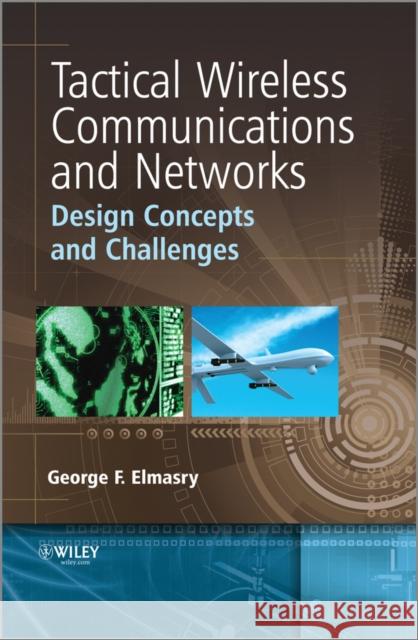
George F. Elmasry
Tactical Wireless Communications and Networks Elmasry, George F. 9781119951766 John Wiley & Sons - książkaWidoczna okładka, to zdjęcie poglądowe, a rzeczywista szata graficzna może różnić się od prezentowanej.

Tactical Wireless Communications and Networks

ISBN-13: 9781119951766 / Angielski / Twarda / 2012 / 336 str.

George F. Elmasry
cena 466,99 zł
(netto: 444,75 VAT:  5%)

Najniższa cena z 30 dni: 462,21 zł
Termin realizacji zamówienia:
ok. 30 dni roboczych
Bez gwarancji dostawy przed świętami

Darmowa dostawa!

Providing a complete description of modern tactical military communications and networks technology, this book systematically compares tactical military communications techniques with their commercial equivalents, pointing out similarities and differences. In particular it examines each layer of the protocol stack and shows how specific tactical and security requirements result in changes from the commercial approach. The author systematically leads readers through this complex topic, firstly providing background on the architectural approach upon which the analysis will be based, and then going into detail on tactical wireless communications and networking technologies and techniques.

  • Structured progressively: for readers needing an overall view; for those looking at the communications aspects (lower layers of the protocol stack); and for users interested in the networking aspects (higher layers of the protocol stack)
  • Presents approaches to alleviate the challenges faced by the engineers in the field today
  • Furnished throughout with illustrations and case studies to clarify the notional and architectural approaches
  • Includes a list of problems for each chapter to emphasize the important aspects of the topics covered
  • Covers the current state of tactical networking as well as the future long term evolution of tactical wireless communications and networking in the next 50 years
  • Written at an advanced level with scope as a reference tool for engineers and scientists as well as a graduate text for advanced courses


Kategorie:
Technologie
Kategorie BISAC:
Technology & Engineering > Mobile & Wireless Communications
Technology & Engineering > Military Science
Wydawca:
John Wiley & Sons
Język:
Angielski
ISBN-13:
9781119951766
Rok wydania:
2012
Ilość stron:
336
Waga:
0.70 kg
Wymiary:
24.38 x 17.02 x 2.54
Oprawa:
Twarda
Wolumenów:
01
Dodatkowe informacje:
Bibliografia

I would like to recommend the book for graduate students, engineers and researchers interested in a general understanding of military wireless network technologies, architectures, and challenges facing future generations of this type of networks.   (IEEE Communications Magazine, 1 July 2014)

About the Author xi

Foreword xiii

Preface xv

List of Acronyms xvii

Part I THEORETICAL BASIS

1 Introduction 3

1.1 The OSI Model 4

1.2 From Network Layer to IP Layer 6

1.3 Pitfall of the OSI Model 7

1.4 Tactical Networks Layers 9

1.5 Historical Perspective 10

Bibliography 11

2 The Physical Layer 13

2.1 Modulation 13

2.1.1 Signal–in–Space (SiS) 16

2.2 Signal Detection 22

2.2.1 Signal Detection in Two–Dimensional Space 24

2.2.2 Multidimensional Constellations for AWGN 28

2.3 Non–Coherent Demodulation 29

2.4 Signal Fading 29

2.5 Power Spectrum 31

2.6 Spread Spectrum Modulation 34

2.6.1 Direct Sequence Spread Spectrum 35

2.6.2 Frequency Hopping Spread Spectrum 38

2.7 Concluding Remarks 40

2.7.1 What Happens Before Modulation and After Demodulation? 40

2.7.2 Historical Perspective 40

Bibliography 41

3 The DLL and Information Theory in Tactical Networks 43

3.1 Information Theory and Channel Capacity 43

3.1.1 Uncertainty and Information 45

3.1.2 Entropy 46

3.1.3 Coding for a Discrete Memoryless Source 48

3.1.4 Mutual Information and Discrete Channels 50

3.1.5 The Binary Symmetric Channel (BSC) Model 53

3.1.6 Capacity of a Discrete Channel 54

3.2 Channel Coding, Error Detection, and Error Correction 57

3.2.1 Hamming Distance and Probability of Bit Error in Channel Coding 58

3.2.2 Overview of Linear Block Codes 60

3.2.3 Convolutional Codes 62

3.2.4 Concatenated Coding and Interleaving 64

3.2.5 Network Coding versus Transport Layer Packet Erasure Coding 65

3.3 Concluding Remarks 67

3.3.1 The Role of Information Theory and Coding in Tactical Wireless Communications and Networking 67

3.3.2 Historical Perspective 68

Appendix 3.A: Using RS Code in Tactical Networks Transport Layer 69

3.A.1 The Utilized RS Code 69

3.A.2 Packet Erasure Analysis 70

3.A.3 Imposed Tactical Requirements 77

Bibliography 80

4 MAC and Network Layers in Tactical Networks 83

4.1 MAC Layer and Multiple Access Techniques 83

4.2 Queuing Theory 87

4.2.1 Statistical Multiplexing of Packets 87

4.2.2 Queuing Models 92

4.3 Concluding Remarks 106

4.3.1 How Congestion Happens in Tactical Wireless Networks 106

4.3.2 Historical Perspective 107

4.3.3 Remarks Regarding the First Part of the Book 108

Bibliography 110

Part II THE EVOLUTION OF TACTICAL RADIOS

5 Non–IP Tactical Radios and the Move toward IP 113

5.1 Multistep Evolution to the Global Information Grid 113

5.2 Link–16 Waveform 114

5.2.1 Link–16 Messages 119

5.2.2 Link Layer Operations of Link–16 120

5.2.3 JTIDS/LINK–16 Modulation and Coding 120

5.2.4 Enhancements to Link–16 126

5.2.5 Concluding Remarks on Link–16 Waveform 129

5.3 EPLRS Waveform 130

5.4 SINCGARS Waveform 131

5.5 Tactical Internet (TI) 131

5.6 IP Gateways 136

5.6.1 Throughput Efficiency 136

5.6.2 End–to–End Packet Loss 137

5.7 Concluding Remarks 137

5.7.1 What Comes after the GIG? 137

5.7.2 Historical Perspective 137

Bibliography 138

6 IP–Based Tactical Waveforms and the GIG 141

6.1 Tactical GIG Notional Architecture 141

6.2 Tactical GIG Waveforms 144

6.2.1 Wide–Area Network Waveform (WNW) 144

6.2.2 Soldier Radio Waveform (SRW) 163

6.2.3 High–Band Networking Waveform (HNW) 164

6.2.4 Network Centric Waveform (NCW) 165

6.3 The Role of Commercial Satellite in the Tactical GIG 166

6.4 Satellite Delay Analysis 166

6.5 Networking at the Tactical GIG 169

6.6 Historical Perspective 170

Bibliography 173

7 Cognitive Radios 177

7.1 Cognitive Radios and Spectrum Regulations 177

7.2 Conceptualizing Cognitive Radios 180

7.2.1 Cognitive Radio Setting (CRS) Parameters 180

7.2.2 The Cognitive Engine 181

7.3 Cognitive Radios in Tactical Environments 183

7.4 Software Communications Architecture (SCA) 184

7.4.1 The SCA Core Framework 185

7.4.2 SCA Definitions 185

7.4.3 SCA Components 186

7.4.4 SCA and Security Architecture 188

7.5 Spectrum Sensing 190

7.5.1 Multidimensional Spectrum Awareness 190

7.5.2 Complexity of Spectrum Sensing 193

7.5.3 Implementation of Spectrum Sensing 195

7.5.4 Cooperative Spectrum Sensing 199

7.5.5 Spectrum Sensing in Current Wireless Standards 200

7.6 Security in Cognitive Radios 201

7.7 Concluding Remarks 201

7.7.1 Development of Cognitive Radios 201

7.7.2 Modeling and Simulation of Cognitive Radios 202

7.7.3 Historical Perspective 202

Bibliography 202

Part III THE OPEN ARCHITECTURE MODEL

8 Open Architecture in Tactical Networks 207

8.1 Commercial Cellular Wireless Open Architecture Model 208

8.2 Tactical Wireless Open Architecture Model 210

8.3 Open Architecture Tactical Protocol Stack Model 211

8.3.1 Tactical Wireless Open Architecture Model Entities 213

8.3.2 Open Architecture Tactical Wireless Model ICDs 216

8.4 The Tactical Edge 219

8.4.1 Tactical Edge Definition 219

8.4.2 Tactical Edge Analysis 220

8.5 Historical Perspective 222

Bibliography 224

9 Open Architecture Details 225

9.1 The Plain Text IP Layer and the Tactical Edge 225

9.2 Measurement Based Resource Management 227

9.2.1 Advantages and Challenges of MBRM 228

9.2.2 Congestion Severity Level 229

9.2.3 Markov Chain Representation of MBAC 231

9.2.4 Regulating the Flow of Traffic between Two Nodes 233

9.2.5 Regulating the Flow of Traffic for Multiple Nodes 233

9.2.6 Packet Loss from the Physical Layer 234

9.3 ICD I: Plain Text IP Layer to HAIPE 238

9.4 ICD V: Plain Text IP Layer Peer–to–Peer 239

9.4.1 TCP Proxy over HAIPE 239

9.4.2 VoIP Proxy over HAIPE 241

9.4.3 Video Proxy over HAIPE 247

9.4.4 RSVP Proxy over HAIPE 248

9.4.5 Multicast Proxy over HAIPE 252

9.5 ICD X Cross Layer Signaling across the HAIPE 255

9.6 Concluding Remarks 258

9.7 Historical Perspective 258

Bibliography 259

10 Bringing Commercial Cellular Capabilities to Tactical Networks 261

10.1 Tactical User Expectations 262

10.2 3G/4G/LTE Technologies within the War Theater 264

10.3 The Tactical Cellular Gateway 265

10.4 Deployment Use Cases 267

10.4.1 Use Case I: Smartphone Tethered to a Soldier Radio Waveform (SRW) Radio 268

10.4.2 Use Case II: 3G/4G/LTE Services on a Dismounted Unit 269

10.4.3 Use Case III: 3G/4G/LTE Access at an Enclave 271

10.5 Concluding Remarks 272

Bibliography 273

11 Network Management Challenges in Tactical Networks 275

11.1 Use of Policy Based Network Management and Gaming Theory in Tactical Networks 275

11.2 Challenges Facing Joint Forces Interoperability 277

11.3 Joint Network Management Architectural Approach 277

11.3.1 Assumptions and Concepts for Operations (ConOps) 279

11.3.2 The Role of Gateway Nodes 281

11.3.3 Abstracting Information 282

11.3.4 Creating Path Information 283

11.3.5 Sequence Diagram 285

11.4 Conflict Resolution for Shared Resources 286

11.4.1 Tactical Network Hierarchy 287

11.4.2 Dynamic Activation of NCW in WNW/NCW–Capable Nodes 287

11.4.3 Interfacing between the WIN–NM and the JWNM for NCW Resources 288

11.4.4 NCW Resource Attributes 289

11.5 Concluding Remarks 290

Bibliography 291

Index 293

Uniquely presents tactical wireless communications and networks from an open architecture model perspective 

Providing a complete description of modern tactical military communications and networks technologies, this book systematically compares tactical military communications techniques with their commercial equivalents, pointing out similarities and differences. The author methodologically leads readers through this complex topic; first providing theoretical background on the protocol stack layers as they relate to tactical wireless communications and networking, second cover legacy, current and future tactical radio, and then going into detail on  the open architecture challenges. 

The book covers legacy non–IP tactical radios, IP–based tactical Mobile Ad–hoc NETwork (MANET) radios, the place of cognitive radios in future tactical communications, as well as the use of  core networks in the tactical theatre. Also presented are the Joint Tactical Radio Systems (JTRS) and other waveforms in the larger context of the Global Information Grid (GIG). This in–depth coverage enables readers to reflect on the security and Network Operations (NetOps) challenges, the need for cross layer signalling, the hypothesis of merging some protocol stack layers, and the techniques that are unique to tactical communications and networking, allowing them to move on to further practical and theoretical considerations.

Key Features:

  • Covers the current state of tactical networking as well as the future long term evolution of tactical wireless communications and networking in the next 50 years
  • Furnished throughout with illustrations and case studies to clarify the notional and architectural approaches
  • Written at an advanced level with scope as a reference tool for engineers and scientists as well as a graduate text for advanced courses




Udostępnij

Facebook - konto krainaksiazek.pl


Opinie o Krainaksiazek.pl na Opineo.pl

Partner Mybenefit

Krainaksiazek.pl w programie rzetelna firma Krainaksiaze.pl - płatności przez paypal

Czytaj nas na:

Facebook - krainaksiazek.pl
  • książki na zamówienie
  • granty
  • książka na prezent
  • kontakt
  • pomoc
  • opinie
  • regulamin
  • polityka prywatności

Zobacz:

  • Księgarnia czeska

  • Wydawnictwo Książkowe Klimaty

1997-2025 DolnySlask.com Agencja Internetowa

© 1997-2022 krainaksiazek.pl
     
KONTAKT | REGULAMIN | POLITYKA PRYWATNOŚCI | USTAWIENIA PRYWATNOŚCI
Zobacz: Księgarnia Czeska | Wydawnictwo Książkowe Klimaty | Mapa strony | Lista autorów
KrainaKsiazek.PL - Księgarnia Internetowa

Polityka prywatnosci - link
Krainaksiazek.pl - płatnośc Przelewy24
Przechowalnia Przechowalnia




