• Wyszukiwanie zaawansowane
  • Kategorie
  • Kategorie BISAC
  • Książki na zamówienie
  • Promocje
  • Granty
  • Książka na prezent
  • Opinie
  • Pomoc
  • Załóż konto
  • Zaloguj się

Model Building in Mathematical Programming » książka


zaloguj się | załóż konto
Logo Krainaksiazek.pl

koszyk

konto

szukaj
topmenu
Księgarnia internetowa
Szukaj
Książki na zamówienie
Promocje
Granty
Książka na prezent
Moje konto
Pomoc
 
 
Wyszukiwanie zaawansowane
Pusty koszyk
Bezpłatna dostawa dla zamówień powyżej 20 złBezpłatna dostawa dla zamówień powyżej 20 zł

Kategorie główne

• Nauka
 [2946912]
• Literatura piękna
 [1852311]

  więcej...
• Turystyka
 [71421]
• Informatyka
 [150889]
• Komiksy
 [35717]
• Encyklopedie
 [23177]
• Dziecięca
 [617324]
• Hobby
 [138808]
• AudioBooki
 [1671]
• Literatura faktu
 [228371]
• Muzyka CD
 [400]
• Słowniki
 [2841]
• Inne
 [445428]
• Kalendarze
 [1545]
• Podręczniki
 [166819]
• Poradniki
 [480180]
• Religia
 [510412]
• Czasopisma
 [525]
• Sport
 [61271]
• Sztuka
 [242929]
• CD, DVD, Video
 [3371]
• Technologie
 [219258]
• Zdrowie
 [100961]
• Książkowe Klimaty
 [124]
• Zabawki
 [2341]
• Puzzle, gry
 [3766]
• Literatura w języku ukraińskim
 [255]
• Art. papiernicze i szkolne
 [7810]
Kategorie szczegółowe BISAC

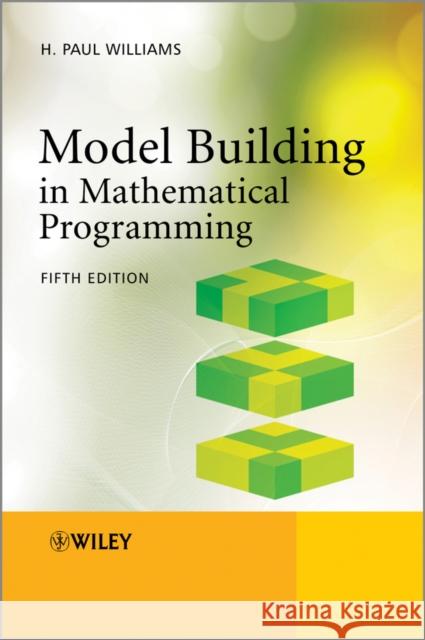
Model Building in Mathematical Programming

ISBN-13: 9781118443330 / Angielski / Miękka / 2013 / 432 str.
H. Paul (London School of Economics) Williams
Model Building in Mathematical Programming H. Paul (London School of Economics) Williams 9781118443330 John Wiley & Sons Inc - książkaWidoczna okładka, to zdjęcie poglądowe, a rzeczywista szata graficzna może różnić się od prezentowanej.

Model Building in Mathematical Programming

ISBN-13: 9781118443330 / Angielski / Miękka / 2013 / 432 str.

H. Paul (London School of Economics) Williams
cena 239,59 zł
(netto: 228,18 VAT:  5%)

Najniższa cena z 30 dni: 238,60 zł
Termin realizacji zamówienia:
ok. 30 dni roboczych
Dostawa w 2026 r.

Darmowa dostawa!

The 5th edition of Model Building in Mathematical Programming discusses the general principles of model building in mathematical programming and demonstrates how they can be applied by using several simplified but practical problems from widely different contexts. Suggested formulations and solutions are given together with some computational experience to give the reader a feel for the computational difficulty of solving that particular type of model. Furthermore, this book illustrates the scope and limitations of mathematical programming, and shows how it can be applied to real situations. By emphasizing the importance of the building and interpreting of models rather than the solution process, the author attempts to fill a gap left by the many works which concentrate on the algorithmic side of the subject.

In this article, H.P. Williams explains his original motivation and objectives in writing the book, how it has been modified and updated over the years, what is new in this edition and why it has maintained its relevance and popularity over the years: http: //www.statisticsviews.com/details/feature/4566481/Model-Building-in-Mathematical-Programming-published-in-fifth-edition.html


Kategorie:
Nauka, Ekonomia i biznes
Kategorie BISAC:
Business & Economics > Production & Operations Management
Mathematics > Programowanie liniowe
Business & Economics > Management Science
Wydawca:
John Wiley & Sons Inc
Język:
Angielski
ISBN-13:
9781118443330
Rok wydania:
2013
Wydanie:
Revised
Ilość stron:
432
Waga:
0.54 kg
Wymiary:
15.24 x 22.86 x 2.29
Oprawa:
Miękka
Wolumenów:
01
Dodatkowe informacje:
Bibliografia
Wydanie ilustrowane

Preface

PART 1

1 Introduction

1.1 The Concept of a Model

1.2 Mathematical Programming Models

2 Solving Mathematical Programming Models

2.1 Algorithms and Packages

2.2 Practical Considerations

2.3 Decision Support and Expert Systems

2.4 Constraint Programming 

3 Building Linear Programming Models

3.1 The Importance of Linearity

3.2 Defining Objectives

3.3 Defining Constraints

3.4 How to Build a Good Model

3.5 The Use of Modelling Languages

4 Structured Linear Programming Models

4.1 Multiple Plant, Product, and Period Models

4.2 Stochastic Programming Models

4.3 Decomposing a Large Model

5 Applications and Special Types of Mathematical Programming Model

5.1 Typical Applications

5.2 Economic Models

5.3 Network Models

5.4 Converting Linear Programs to Networks

6 Interpreting and Using the Solution of a Linear Programming Model

6.1 Validating a Model

6.2 Economic Interpretations

6.3 Sensitivity Analysis and the Stability of a Model

6.4 Further Investigations Using a Model

6.5 Presentation of the Solutions

7 Non–linear Models

7.1 Typical Applications

7.2 Local and Global Optima

7.3 Separable Programming

7.4 Converting a Problem to a Separable Model

8 Integer Programming

8.1 Introduction

8.2 The Applicability of Integer Programming

8.3 Solving Integer Programming Models

9 Building Integer Programming Models I

9.1 The Uses of Discrete Variables

9.2 Logical Conditions and Zero One Variables

9.3 Special Ordered Sets of Variables

9.4 Extra Conditions Applied to Linear Programming Models

9.5 Special Kinds of Integer Programming Model

9.6 Column Generation

10 Building Integer Programming Models II

10.1 Good and Bad Formulations

10.2 Simplifying an Integer Programming Model

10.3 Economic Information Obtainable by Integer Programming

10.4 Sensitivity Analysis and the Stability of a Model

10.5 When and How to Use Integer Programming

11 The Implementation of a Mathematical Programming System of Planning

11.1 Acceptance and Implementation

11.2 The Unification of Organizational Functions

11.3 Centralization versus Decentralization

11.4 The Collection of Data and the Maintenance of a Model

PART 2

12 The Problems

12.1 Food Manufacture 1

When to buy and how to blend

12.2 Food Manufacture 2

Limiting the number of ingredients and adding extra conditions

12.3 Factory Planning 1

What to make, on what machines, and when

12.4 Factory Planning 2

When should machines be down for maintenance

12.5 Manpower Planning

How to recruit, retrain, make redundant, or overman

12.6 Refinery Optimization

How to run an oil refinery

12.7 Mining

Which pits to work and when to close them down

12.8 Farm Planning

How much to grow and rear

12.9 Economic Planning

How should an economy grow

12.10 Decentralization

How to disperse offices from the capital

12.11 Curve Fitting

Fitting a curve to a set of data points

12.12 Logical Design

Constructing an electronic system with a minimum number of components

12.13 Market Sharing

Assigning retailers to company divisions

12.14 Opencast Mining

How much to excavate

12.15 Tariff Rates (Power Generation)

How to determine tariff rates for the sale of electricity

12.16 Hydro Power

How to generate and combine hydro and thermal electricity generation

12.17 Three–dimensional Noughts and Crosses

A combinatorial problem

12.18 Optimizing a Constraint

Reconstructing an integer programming constraint more simply

12.19 Distribution 1

Which factories and depots to supply which customers

12.20 Depot Location (Distribution 2)

Where should new depots be built

12.21 Agricultural Pricing

What prices to charge for dairy products

12.22 Efficiency Analysis

How to use data envelopment analysis to compare efficiencies of garages

12.23 Milk Collection

How to route and assign milk collection lorries to farms

12.24 Yield Management

What quantities of airline tickets to sell at what prices and what times

12.25 Car Rental 1

How many cars to own and where to locate them

12.26 Car Rental 2

Where should repair capacity be increased

12.27 Lost Baggage Distribution

Which vehicles should go to which customers and in what order

12.28 Protein Folding

How a string of Amino Acids is likely to fold

12.29 Protein Comparison

How similar are two proteins

PART 3

13 Formulation and Discussion of Problems

13.1 Food Manufacture 1

13.2 Food Manufacture 2

13.3 Factory Planning 1

13.4 Factory Planning 2

13.5 Manpower Planning

13.6 Refinery Optimization

13.7 Mining

13.8 Farm Planning

13.9 Economic Planning

13.10 Decentralization

13.11 Curve Fitting

13.12 Logical Design

13.13 Market Sharing

13.14 Opencast Mining

13.15 Tariff Rates (Power Generation)

13.16 Hydro Power

13.17 Three–dimensional Noughts and Crosses

13.18 Optimizing a Constraint

13.19 Distribution 1

13.20 Depot Location (Distribution 2)

13.21 Agricultural Pricing

13.22 Efficiency Analysis

13.23 Milk Collection

13.24 Yield Management

13.25 Car Rental 1

13.26 Car Rental 2

13.27 Lost Baggage Distribution

13.28 Protein Folding

13.29 Protein Comparison

PART 4

14 Solutions to Problems

14.1 Food Manufacture 1

14.2 Food Manufacture 2

14.3 Factory Planning 1

14.4 Factory Planning 2

14.5 Manpower Planning

14.6 Refinery Optimization

14.7 Mining

14.8 Farm Planning

14.9 Economic Planning

14.10 Decentralization

14.11 Curve Fitting

14.12 Logical Design

14.13 Market Sharing

14.14 Opencast Mining

14.15 Tariff Rates (Power Generation)

14.16 Hydro Power

14.17 Three–dimensional Noughts and Crosses

14.18 Optimizing a Constraint

14.19 Distribution 1

14.20 Depot Location (Distribution 2)

14.21 Agricultural Pricing

14.22 Efficiency Analysis

14.23 Milk Collection

14.24 Yield Management

14.25 Car Rental 1

14.26 Car Rental 2

14.27 Lost Baggage Distribution

14.28 Protein Folding

14.29 Protein Comparison

References

Author Index

Subject Index

H. Paul Williams, London School of Economics, UK

Model Building in Mathematical Programming covers a wide range of applications in many diverse areas, such as operational research, systems engineering, agriculture, energy planning, mining, logistics and distribution, computer science, management science, statistics, applied mathematics and mathematical biology. Model Building in Mathematical Programming aims to provide students with a solid foundation in the principles of model building as well as the more mathematical, algorithmic side of the subject which is conventionally taught. It is also intended to provide managers with a fairly non–technical appreciation of the scope and limitations of mathematical programming.   Praise for the 4th Edition: ′Such a text, and this is the only one of this type I know of, should be the basis of all instruction in Mathematical Programming.′ Journal of the Royal Statistical Society ′An excellent introduction ... for students of business administration and people who want to see the utility of operations research.′ European Journal of Operational Research     This new edition includes:  New sections on stochastic programming, column generation and constraint logic programming as well as many enhancements of former sections.   29 detailed practical problems, including 5 new problems, to enable the reader to build mathematical programming models using the numerical data.    


Udostępnij

Facebook - konto krainaksiazek.pl


Opinie o Krainaksiazek.pl na Opineo.pl

Partner Mybenefit

Krainaksiazek.pl w programie rzetelna firma Krainaksiaze.pl - płatności przez paypal

Czytaj nas na:

Facebook - krainaksiazek.pl
  • książki na zamówienie
  • granty
  • książka na prezent
  • kontakt
  • pomoc
  • opinie
  • regulamin
  • polityka prywatności

Zobacz:

  • Księgarnia czeska

  • Wydawnictwo Książkowe Klimaty

1997-2025 DolnySlask.com Agencja Internetowa

© 1997-2022 krainaksiazek.pl
     
KONTAKT | REGULAMIN | POLITYKA PRYWATNOŚCI | USTAWIENIA PRYWATNOŚCI
Zobacz: Księgarnia Czeska | Wydawnictwo Książkowe Klimaty | Mapa strony | Lista autorów
KrainaKsiazek.PL - Księgarnia Internetowa

Polityka prywatnosci - link
Krainaksiazek.pl - płatnośc Przelewy24
Przechowalnia Przechowalnia






