• Wyszukiwanie zaawansowane
  • Kategorie
  • Kategorie BISAC
  • Książki na zamówienie
  • Promocje
  • Granty
  • Książka na prezent
  • Opinie
  • Pomoc
  • Załóż konto
  • Zaloguj się

Fuzzy Cognitive Maps: Advances in Theory, Methodologies, Tools and Applications » książka


zaloguj się | załóż konto
Logo Krainaksiazek.pl

koszyk

konto

szukaj
topmenu
Księgarnia internetowa
Szukaj
Książki na zamówienie
Promocje
Granty
Książka na prezent
Moje konto
Pomoc
 
 
Wyszukiwanie zaawansowane
Pusty koszyk
Bezpłatna dostawa dla zamówień powyżej 20 złBezpłatna dostawa dla zamówień powyżej 20 zł

Kategorie główne

• Nauka
 [2946600]
• Literatura piękna
 [1856966]

  więcej...
• Turystyka
 [72221]
• Informatyka
 [151456]
• Komiksy
 [35826]
• Encyklopedie
 [23190]
• Dziecięca
 [619653]
• Hobby
 [140543]
• AudioBooki
 [1577]
• Literatura faktu
 [228355]
• Muzyka CD
 [410]
• Słowniki
 [2874]
• Inne
 [445822]
• Kalendarze
 [1744]
• Podręczniki
 [167141]
• Poradniki
 [482898]
• Religia
 [510455]
• Czasopisma
 [526]
• Sport
 [61590]
• Sztuka
 [243598]
• CD, DVD, Video
 [3423]
• Technologie
 [219201]
• Zdrowie
 [101638]
• Książkowe Klimaty
 [124]
• Zabawki
 [2473]
• Puzzle, gry
 [3898]
• Literatura w języku ukraińskim
 [254]
• Art. papiernicze i szkolne
 [8170]
Kategorie szczegółowe BISAC

Fuzzy Cognitive Maps: Advances in Theory, Methodologies, Tools and Applications

ISBN-13: 9783642032196 / Angielski / Twarda / 2010 / 200 str.
Michael Glykas
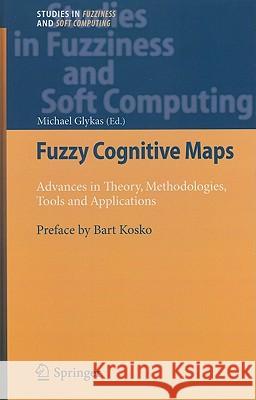
Fuzzy Cognitive Maps: Advances in Theory, Methodologies, Tools and Applications Michael Glykas 9783642032196 Springer-Verlag Berlin and Heidelberg GmbH &  - książkaWidoczna okładka, to zdjęcie poglądowe, a rzeczywista szata graficzna może różnić się od prezentowanej.

Fuzzy Cognitive Maps: Advances in Theory, Methodologies, Tools and Applications

ISBN-13: 9783642032196 / Angielski / Twarda / 2010 / 200 str.

Michael Glykas
cena 605,23 zł
(netto: 576,41 VAT:  5%)

Najniższa cena z 30 dni: 578,30 zł
Termin realizacji zamówienia:
ok. 22 dni roboczych
Bez gwarancji dostawy przed świętami

Darmowa dostawa!
inne wydania

This important edited volume is the first such book ever published on fuzzy cognitive maps (FCMs). Professor Michael Glykas has done an exceptional job in bringing together and editing its seventeen chapters. The volume appears nearly a quarter century after my original article "Fuzzy Cognitive Maps" appeared in the International Journal of Man-Machine Studies in 1986. The volume accordingly reflects many years of research effort in the development of FCM theory and applications--and portends many more decades of FCM research and applications to come. FCMs are fuzzy feedback models of causality. They combine aspects of fuzzy logic, neural networks, semantic networks, expert systems, and nonlinear dynamical systems. That rich structure endows FCMs with their own complexity and lets them apply to a wide range of problems in engineering and in the soft and hard sciences. Their partial edge connections allow a user to directly represent causality as a matter of degree and to learn new edge strengths from training data. Their directed graph structure allows forward or what-if inferencing. FCM cycles or feedback paths allow for complex nonlinear dynamics. Control of FCM nonlinear dynamics can in many cases let the user encode and decode concept patterns as fixed-point attractors or limit cycles or perhaps as more exotic dynamical equilibria. These global equilibrium patterns are often "hidden" in the nonlinear dynamics. The user will not likely see these global patterns by simply inspecting the local causal edges or nodes of large FCMs.


Kategorie:
Informatyka, Bazy danych
Kategorie BISAC:
Technology & Engineering > Engineering (General)
Computers > Artificial Intelligence - General
Business & Economics > Operations Research
Wydawca:
Springer-Verlag Berlin and Heidelberg GmbH &
Seria wydawnicza:
Studies in Fuzziness and Soft Computing
Język:
Angielski
ISBN-13:
9783642032196
Rok wydania:
2010
Dostępne języki:
Angielski
Wydanie:
2010
Numer serii:
000044347
Ilość stron:
200
Waga:
0.92 kg
Wymiary:
23.523.5 x 15.5
Oprawa:
Twarda
Wolumenów:
01
Dodatkowe informacje:
Bibliografia
Wydanie ilustrowane

Fuzzy Cognitive Maps: Basic Theories and Their Application to Complex Systems.- Expert-Based and Computational Methods for Developing Fuzzy Cognitive Maps.- A Novel Approach on Constructed Dynamic Fuzzy Cognitive Maps Using Fuzzified Decision Trees and Knowledge-Extraction Techniques.- The FCM Designer Tool.- Fuzzy Cognitive Networks: Adaptive Network Estimation and Control Paradigms.- Modeling of Operative Risk Using Fuzzy Expert Systems.- Fuzzy Cognitive Maps in Banking Business Process Performance Measurement.- Fuzzy Cognitive Maps-Based IT Projects Risks Scenarios.- Software Reliability Modelling Using Fuzzy Cognitive Maps.- Fuzzy Cognitive Networks for Maximum Power Point Tracking in Photovoltaic Arrays.- Fuzzy Cognitive Maps Applied to Computer Vision Tasks.- Classifying Patterns Using Fuzzy Cognitive Maps.- Dynamic Fuzzy Cognitive Maps for the Supervision of Multiagent Systems.- Soft Computing Technique of Fuzzy Cognitive Maps to Connect Yield Defining Parameters with Yield in Cotton Crop Production in Central Greece as a Basis for a Decision Support System for Precision Agriculture Application.- Analysis of Farmers’ Concepts of Environmental Management Measures: An Application of Cognitive Maps and Cluster Analysis in Pursuit of Modelling Agents’ Behaviour.- Using Fuzzy Cognitive Maps to Support the Analysis of Stakeholders’ Views of Water Resource Use and Water Quality Policy.- Fuzzy Cognitive Map to Support Conflict Analysis in Drought Management.

The theory of cognitive maps was developed in 1976. Its main aim was the representation of (causal) relationships among “concepts” also known as “factors” or “nodes”. Concepts could be assigned values. Causal relationships between two concepts could be of three types: positive, negative or neutral. Increase in the value of a concept would yield a corresponding positive or negative increase at the concepts connected to it via relationships. In 1986 Bart Kosko introduced the notion of fuzziness to cognitive maps and created the theory of Fuzzy Cognitive Maps (FCMs). The relationship between two concepts in (FCMs) can take a value in the interval [-1,1]. This relationship value is called “weight”. For the last twenty years extensive research in the theory of FCMs has been performed that provided major improvements and enhancements in its theoretical underpinning. New methodologies and approaches have been developed. FCMs have also been applied to many different sectors. New software tools have been developed that automate FCM creation and management. The aim of this book is to present recent advances and state of the art in FCM theory, methodologies, applications and tools that exist to date scattered in journal papers, in a concrete and integrated manner.


Udostępnij

Facebook - konto krainaksiazek.pl


Opinie o Krainaksiazek.pl na Opineo.pl

Partner Mybenefit

Krainaksiazek.pl w programie rzetelna firma Krainaksiaze.pl - płatności przez paypal

Czytaj nas na:

Facebook - krainaksiazek.pl
  • książki na zamówienie
  • granty
  • książka na prezent
  • kontakt
  • pomoc
  • opinie
  • regulamin
  • polityka prywatności

Zobacz:

  • Księgarnia czeska

  • Wydawnictwo Książkowe Klimaty

1997-2025 DolnySlask.com Agencja Internetowa

© 1997-2022 krainaksiazek.pl
     
KONTAKT | REGULAMIN | POLITYKA PRYWATNOŚCI | USTAWIENIA PRYWATNOŚCI
Zobacz: Księgarnia Czeska | Wydawnictwo Książkowe Klimaty | Mapa strony | Lista autorów
KrainaKsiazek.PL - Księgarnia Internetowa

Polityka prywatnosci - link
Krainaksiazek.pl - płatnośc Przelewy24
Przechowalnia Przechowalnia






